

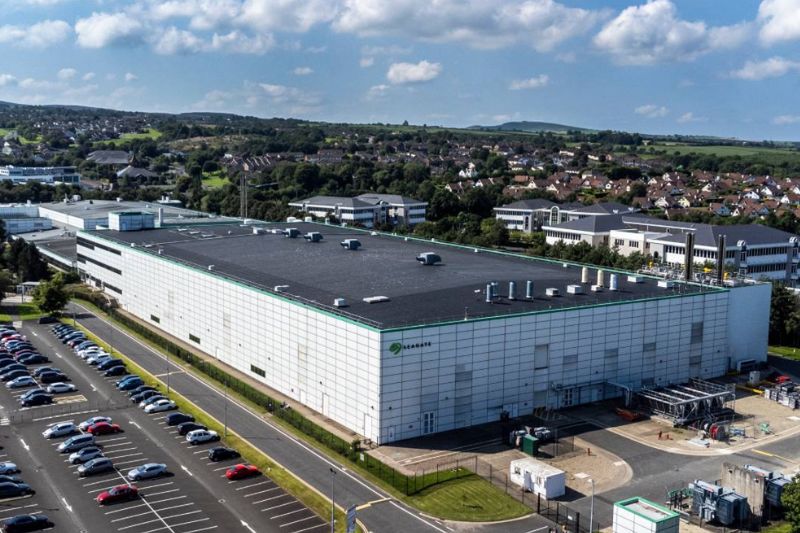
Seagate Technology is advancing the construction of a new three-storey cleanroom facility in Derry, Northern Ireland.
On 13 March, Seagate submitted a planning application to the Derry City and Strabane District Council to partially demolish the existing, single-storey cleanroom on the Derry site and replace it with a new, three-storey extended cleanroom.
The company selected ABN Cleanroom Technology last year to deliver the new ISO Class 6 cleanroom facility.
The expansion is funded by Seagate’s £100m investment in the North West over the next 5 years and supported by £15m of funding from Invest Northern Ireland (Invest NI).
The current facility is used to develop and manufacture hard disk drives capable of storing 60 terabytes (TB) of data, surpassing today’s top capacity of 36 TB.
“To unlock data’s full potential, we need storage solutions that are not only massive in capacity but engineered for reliability, durability, and scale. That’s exactly what this investment enables,” said John Morris, CTO of Seagate Technology.
What will the expanded cleanroom feature?
A key feature of the new facility will be the integration of the patented VIX concept, designed to maximise airflow efficiency and allow for seamless integration of HVAC systems within the cleanroom’s plenum space.
The project will also be delivered using the modular ADAPTUS product platform, which enables fast-track construction within just four months, without compromising on quality, regulatory compliance, or operational performance.
The current one-storey facility is already recognised as a global centre of excellence for recording-head manufacturing and nanophotonics R&D engineering that supports next-generation drives capable of significantly higher capacities.
Seagate’s Derry/Londonderry fab is one of only five facilities worldwide that develop and manufacture the nano-photonic components of hard drives.
Since establishing operations in Derry in the early 1990s, Seagate has grown into one of the city’s largest employers and a key contributor to the local technology ecosystem.
The addition of around 80 highly skilled roles will support engineering, manufacturing and research activities tied to next-generation storage technology programmes.
The project is also expected to generate wider benefits for local supply chains, specialist equipment providers and research partners involved in advanced manufacturing and photonics development.