
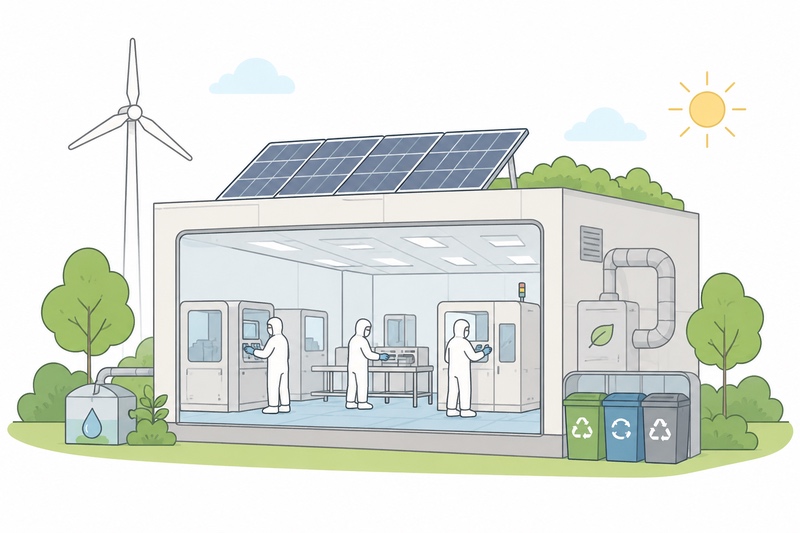
Pharmaceutical cleanrooms have always been engineered around certainty. Certainty that particle levels remain within limits. Certainty that pressure cascades protect against cross contamination. Certainty that temperature and humidity never compromise product integrity. For decades, this certainty has been achieved by designing ventilation systems for worst case conditions and operating them continuously at that level.
Today, however, the operating environment around cleanrooms is changing. Energy prices have risen sharply. Sustainability targets are embedded in corporate strategies. Regulators and investors alike expect measurable reductions in environmental impact. In this new context, a fundamental question is emerging across the industry: Must cleanrooms always run at maximum airflow, even when maximum conditions do not exist?
Cleanrooms designed for safety not efficiency
Pharmaceutical cleanrooms were never designed to be energy efficient. They were designed to eliminate contamination risk and ensure product integrity. Every engineering decision from filtration levels to pressure cascades has been guided by that objective.
This philosophy explains why cleanrooms consume far more energy than most other areas of pharmaceutical facilities. The HVAC system alone accounts for a significant portion of total site energy use. It must continuously remove airborne particles, maintain strict temperature limits, control humidity within narrow tolerances and preserve carefully engineered pressure differentials between rooms.
Air change rates typically range from five to sixty air changes per hour, depending on cleanliness classification and manufacturing process. Higher classifications demand more airflow and more filtration. Higher filtration efficiency creates greater pressure drop across filters, which increases fan energy consumption. Add humidity control, often supported by steam generation and sometimes via electric boilers, and energy demand rises further. Lighting levels are also substantially higher than in conventional industrial spaces.
Cleanrooms are intentionally energy intensive because their environmental requirements are fundamentally different from the rest of the facility.
The constant airflow tradition
For decades, cleanroom ventilation has operated on a constant volume philosophy. Systems are designed for worst case occupancy and worst-case process conditions, and they run at that level continuously.
The rationale has been practical. Environmental stability is easier to validate than variability. Pressure cascades between rooms are critical for preventing cross contamination. Any fluctuation in airflow risks disturbing these pressure relationships.
In an industry where an environmental deviation can result in rejected batches worth millions, stability has outweighed optimisation.
Even during downtime, when rooms are unoccupied and processes inactive, ventilation has traditionally continued at full design levels. The perceived risk of reducing airflow was considered greater than the cost of maintaining it.
Why ventilation has entered the sustainability debate
What has changed is not contamination control science but context. Energy prices and carbon costs have placed operational expenditure under scrutiny. Environmental legislation and corporate sustainability commitments have intensified. Pharmaceutical companies are increasingly evaluated not only on compliance and quality, but also on carbon footprint and energy performance.
HVAC systems are often the largest energy consumers on site. That makes cleanroom ventilation a natural focus in sustainability discussions. What was once purely an engineering matter is now a strategic issue for management and sustainability teams.
For executives, energy efficiency affects competitiveness and brand reputation. For sustainability professionals, ventilation represents measurable carbon reduction potential. For engineers, evolving legislation and energy targets introduce new design constraints. The conversation has expanded beyond airflow calculations to corporate responsibility and long-term resilience.
Beyond the simplistic lower the ACR narrative
It is tempting to frame the issue as a simple reduction of air change rates. That narrative is incomplete.
Airflow is only one element within a complex environmental control system. True optimisation requires a holistic view


