

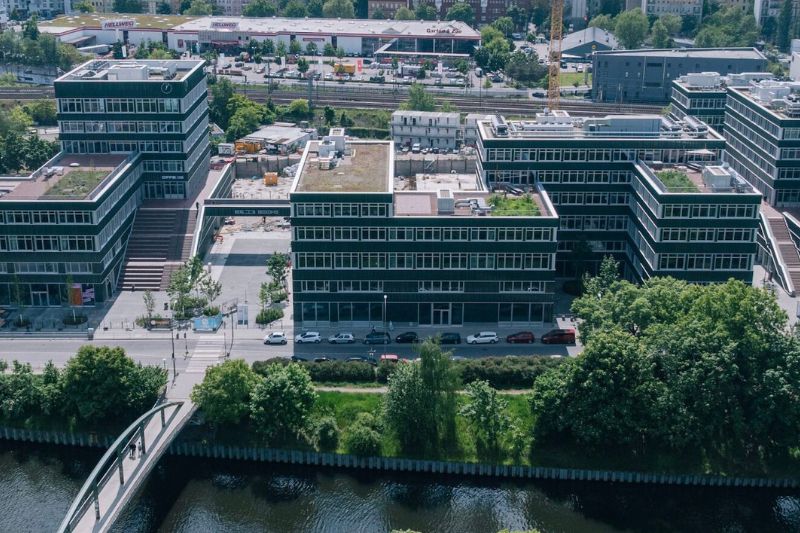
German-American Earth observation company, Planet Labs, is building a new satellite manufacturing facility in Berlin that will house advanced ISO Class 6 and 7 cleanrooms for the assembly, integration and testing of next-gen Earth observation satellites.
The construction schedule runs from January 2026 to April 2027.
The 5,000 sqm European Space Hub will consolidate satellite manufacturing, engineering, mission operations and business functions at a single site, supporting production of satellites for the company's next-generation Pelican constellation.
Planet Labs operates the world's largest fleet of commercial Earth observation satellites.
The company’s spacecraft provide high-resolution imagery with rapid revisit times for applications including environmental monitoring, disaster response, infrastructure inspection, agriculture and climate research.
The Berlin facility forms part of the company's wider investment to expand manufacturing capacity in Europe and strengthen regional access to commercial Earth observation capabilities.
The demand for satellites is expected to increase globally, with a recent study predicting that the global space market will quadruple by 2040, rising from around €500bn to €2tr.
The investment, first announced in 2025, will approximately double production capacity for Planet's Pelican satellites while supporting the creation of up to 70 new highly skilled jobs in Germany.
The project is being managed by construction and real estate consultancy Drees & Sommer.
The team is responsible for overall project management, including cost, schedule, technical coordination and quality management, while ensuring the facility meets the stringent environmental and engineering requirements associated with aerospace cleanroom manufacturing.
At the heart of the development are high-specification ISO Class 6 and 7 cleanrooms, where sensitive satellite hardware, including optical systems, telescopes, cameras, sensors and electronic components, will be assembled and tested under tightly controlled environmental conditions.
The cleanrooms will maintain precise temperature, humidity and airborne particle levels to protect contamination-sensitive components during assembly, integration and testing, helping to ensure the reliability and performance of satellites before launch.
While the building is under construction, Planet Labs Germany has already begun active recruitment for leadership and technical roles that will also support operations ahead of the site’s opening.
"At our European Space Hub, we will have satellite manufacturing, engineering, mission operations and business operations under one roof,” said Martin Polak, Managing Director of Planet Labs Germany.
The facility will manufacture satellites for Planet's Pelican constellation fleet, designed to deliver higher-resolution imagery, increased imaging capacity and faster revisit rates than previous generations of spacecraft.


