

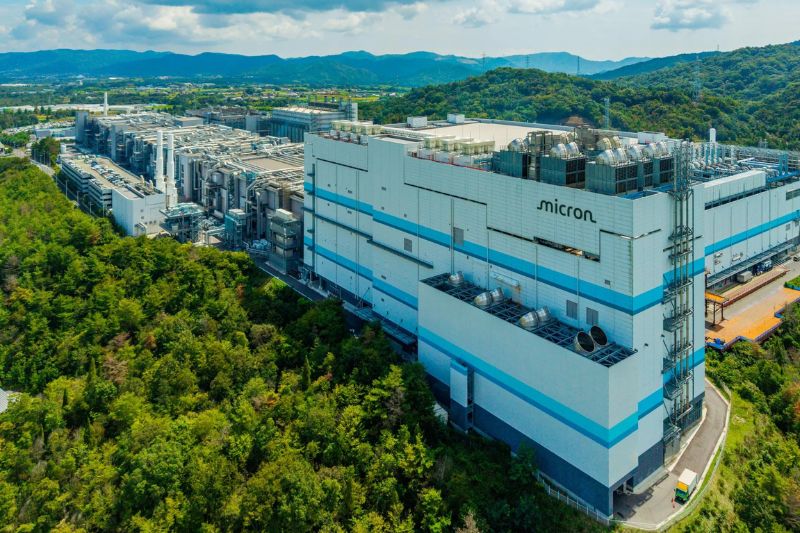
Micron Technology has broken ground on a major expansion of its semiconductor manufacturing campus in Hiroshima Prefecture, marking the start of a ¥1.5tn ($9.3bn) investment that will significantly increase production of advanced memory devices for artificial intelligence applications.
The project will add approximately 28,000 sqm of cleanroom space to the existing facility, supporting the manufacture of next-generation DRAM and high-bandwidth memory (HBM) products.
The fab will include advanced 1-gamma and 1-delta process technologies and HBM4E devices designed for AI accelerators and data centre workloads. Commercial production is expected to begin in 2028.
Japan's Ministry of Economy, Trade and Industry (METI) has committed up to ¥500bn ($3.08bn) towards the project, with cumulative government support for Micron's Hiroshima operations reaching approximately ¥775bn ($4.77bn), reflecting the country's continued investment in strengthening domestic semiconductor manufacturing and supply chain resilience.
The investment forms part of Micron's broader global manufacturing expansion, alongside new fabrication projects in Boise, Idaho, Virginia, New York, and Singapore.
The company is increasing DRAM production capacity to meet growing demand driven by AI servers, high-performance computing and cloud infrastructure.
Micron also announced a long-term supply agreement with Ford to provide memory and storage solutions for the automaker's next-generation vehicles, with production supported by the company's expanding automotive memory capacity, including its Manassas, Virginia fabrication facility.
Construction of the Hiroshima expansion is expected to continue through 2028, with the new cleanroom facilities supporting both front-end wafer fabrication and associated manufacturing infrastructure required for advanced memory production.
Separately, speaking during a post-Cabinet press conference ahead of the Hiroshima groundbreaking ceremony, METI minister Ryosei Akazawa described the European Union's tighter steel import measures as "highly regrettable". He said Japan would continue to press the EU to ensure smooth trade while emphasising the contribution of Japan's steel industry to European industrial competitiveness.


