
Contec Cleanroom EMEA’s Cleanovators Virtual Conference 2026 examined practical challenges in cleanroom cleaning and contamination control, with four technical sessions covering detergent selection, disinfectant implementation, wipe performance and findings from five years of global assessments.
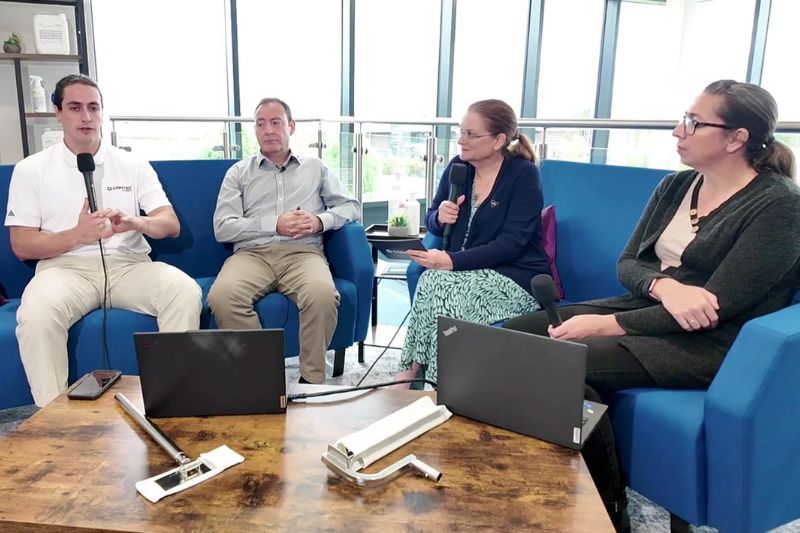
The event featured technical specialists Karen Rossington, EMEA Marketing Manager; Neil Simpson, EMEA Technical Services Group Manager; Harry McBride, EMEA Product Manager; and Marie Wright, Technical Services Specialist.
Cleaning, detergents and disinfectants
Rossington, Simpson and McBride opened with Clean with Confidence: Understanding Detergents, Managing Residues & Optimising Cleanroom Cleaning, which included a practical demonstration of the PowerMop CE system.
The session highlighted the importance of residue management, including an example of a facility that cleaned daily but experienced sticky floors and slippery surfaces.
Wright and Rossington then presented From Validation to Implementation: Successfully Introducing a Cleanroom Disinfectant, examining the steps involved in introducing a disinfectant following validation and qualification.
Cleanroom wipe selection and use
In Wiping Matters: Understanding Cleanroom Wipe Selection & Use, Rossington and Simpson examined five factors affecting wipe performance: cleanliness, absorbency, weight, residues and specific ions.
The session also covered compatibility between wipe materials and cleaning chemistries.
While 70% isopropyl alcohol (IPA) is compatible with most wipe materials, hydrogen peroxide can degrade some substrates, hypochlorite may attack cellulose-containing materials, and quaternary ammonium compounds can bind to certain fibres, potentially reducing the available active ingredient.
The speakers also identified inconsistent wiping technique as a common cleaning mistake, including operators scrunching wipes in their hands rather than following standard operating procedures (SOPs).
Findings from 140 contamination control assessments
Simpson presented Contamination Control in Practice: Lessons from Five Years of Global Assessments, drawing on 140 on-site assessments across different sectors, cleanroom grades and regions.
The assessments examined cleaning and disinfection, material transfer, microbial control, operator technique and regulatory alignment.
Findings showed that 77% of sites implemented changes following their assessment.
Microbial contamination concerns were reported at 26% of sites.
Of those concerns, 72% involved mould and 28% involved bacterial contamination.
The presentation also reported that 70% of bacterial contamination cases involved bacterial spores, while 4% of sites did not use a sporicide.
The findings highlighted the importance of application method, surface coverage, contact time and operator technique alongside product selection.
Among sites using alcohol, 17% relied on spray-only application rather than pre-saturated wipes.
The session also considered EU GMP Annex 1 and its expectation for a holistic Contamination Control Strategy (CCS), bringing together cleaning and residue removal, disinfection, material transfer, operator training, environmental monitoring and risk management.
Q&A addresses practical cleaning challenges
The closing Q&A with Harry McBride, Karen Rossington, Neil Simpson and Marie Wright addressed questions about mop coverage, disinfectant rotation, residue management and surface disinfection.
Asked about the maximum surface area that could be disinfected with a mop, speakers emphasised the importance of understanding the products being used and ensuring the required wet contact time was achieved.
Delegates also asked about cleaning room corners with the PowerMop CE system and its environmental impact, while glass was identified as a particularly challenging surface to disinfect.
On disinfectant rotation, the discussion addressed alternating between sporicidal and non-sporicidal products.
The guidance in the presentation indicated that a three-month rotation could be acceptable where both products contained the same detergent.
Speakers also identified common cleaning mistakes, including failing to account for detergent residues and scrunching wipes in the hand rather than following the wiping techniques set out in standard operating procedures (SOPs).
They stressed that contact times must be established and cleaning procedures consistently applied.
Reflecting on the 140 contamination control assessments, one example involved a facility that cleaned daily and used detergent every day but still experienced sticky floors and slippery surfaces.
The case highlighted how frequent cleaning does not necessarily prevent residue build-up if detergent use and removal are not properly managed.