
Integrated circuits (ICs) power our digital world and they are a vital part of data centres. With surging demand for data centres globally, and predictions of the CAGR doubling in the next seven years, the need for semiconductor fabrication facilities (fabs) are increasingly needed to build ICs.
Adding to this is the significant trend toward reshoring semiconductor manufacturing in the United States and Europe, driven by factors like national security concerns, supply chain fragility, and substantial government subsidies. The move towards reshoring manufacturing is critical to maintaining worldwide competitiveness.
However, the development of data centres and fabs is as complicated as the technology they deliver. Skanska, a global development and construction firm, is at the heart of helping to address their high demand and the challenges owners may face through design and construction.
In this article, we will discuss some critical considerations when designing and building high-tech facilities.
The first step: Deciding where to build
When a semiconductor manufacturer or hyperscale cloud operator begins evaluating potential site locations, the criteria are far more complex than simply “finding a big piece of inexpensive land.”
Choosing a location for a fab or hyperscale data centre is a complex decision involving aspects like engineering, labour availability, local incentives, water access, reliable and redundant power, environmental factors, and community impact. These decisions influence every stage of design and construction, and ultimately determine long-term success.
Water and power: While fabs and data centres are resource-intensive, they also present an opportunity to lead with innovation in sustainable operations and design. For example, semiconductor fabs require millions of gallons of ultra-pure water. However, “use” does not mean “consume.” Most water is withdrawn and treated and then returned. The fraction that is truly consumed is the portion that results from evaporation from cooling and scrubber systems.
As the International Roadmap for Devices and Systems (IRDS) states, “An average semiconductor facility uses millions of gallons per day, and the largest single loss pathway is cooling towers.”
Data centres generate enormous heat and so cooling them is one of the biggest operational expenses. By choosing to build a facility in cold regions, operators can use free air cooling, bringing in filtered outdoor air to cool servers rather than relying entirely on mechanical cooling. Free air cooling is more sustainable and drastically reduces energy use, resulting in lower operating costs, less water usage, fewer environmental refrigerants and greater sustainability.
Government incentives: High-tech facilities are also being built in places like Arizona, Texas, and Georgia, where land is plentiful and affordable. Building in these environments can introduce challenges, but the benefits are often found in the incentives, especially for semiconductor fabs. Semiconductor fabs need people—thousands of them. These are highly technical, well-paying, long-term jobs that help enhance communities, so many states will offer incentives.
However, we are starting to see a difference in the incentives local governments offer for semiconductor facilities versus data centres. Data centres need land, water, power, and low community friction—that’s why many data centres are built in rural areas in states like Texas, Oklahoma, or Nebraska.
Location challenges for builders
Data centre and fab construction projects can require thousands of trade workers—electricians, mechanical trades, specialty engineers, and cleanroom experts. In rural areas, workers are forced to travel and spend extended time away from their families. In addition, there may not be enough housing or hotels, so temporary housing structures are needed.
Weather also influences schedule and cost and planning construction schedules around it is critical. For example, in New York, winter prevents breaking ground or pouring concrete; in Texas and Arizona, extreme heat limits worker hours in the summer; and in Oregon, rain dictates when building envelope and roofing must be completed. In some regions, if certain milestones are not met before winter, the construction schedule is pushed—or forced into costly temporary heating solutions.
Modular construction and skid systems: Modular construction is transforming fab and data centre delivery and helping to make them more sustainable. Skanska routinely builds major systems—waste processing, chiller assemblies, exhaust systems—offsite as modular “skids.” In cleanrooms, modularity also applies to ceiling grid systems, wall panels, and air-handling units (eg, FFUs and HEPA filtration assemblies).
This helps address some of the labour challenges as it reduces the need for large amounts of on-site labour in remote locations. Modular skid systems are manufactured in a controlled and safe environment where you can achieve higher-quality welding and assembly. Additionally, instead of bringing the trade workers to the jobsite, the skids are where the workers and talent are. Once delivered to the project, hours in the field are minimised. Thus streamlining the schedule because they are so quick to install.
Designing for climate and disaster: Semiconductor equipment can cost hundreds of millions of dollars per unit. In semiconductor manufacturing, even small vibrations can affect yields. Protecting these assets requires designing for the environment.
- In Oregon and California, seismic consultants analyse the impact of vibrations on sensitive fab tools.
- In Texas, designs account for tornado risk.
- In Arizona, equipment may require sun shields and reflective exterior coatings and colours.
- In New York, roofs are engineered for massive snow loads.
Redundant power systems and backup planning: Both fabs and data centres cannot lose power… ever. To address this, buildings might feature dual feeds from separate electrical grids, backup generators, and battery storage systems. The industry is also exploring the possible use of alternative energy sources, such as small modular nuclear reactors (SMRs), to meet power demand.
The future of construction
At Skanska, its teams aren’t just constructing facilities for AI—they are deploying it. AI is used as a field tool to improve design quality, accelerate schedules, and make job sites safer. For example, Skanska is implementing AI-supported design reviews to detect conflicts before construction. Onsite, AI pulls relevant safety instructions instantly and robots scan the construction zone at night to identify hazards before workers arrive. Skanska also developed its own AI tool, Safety Sidekick, to enhance safety planning efforts.
While construction approaches are becoming more automated and more modular, the core focus remains unchanged: customer satisfaction. Automation and AI can’t replace customer relationships or team experience, which is at the heart of Skanska’s business.
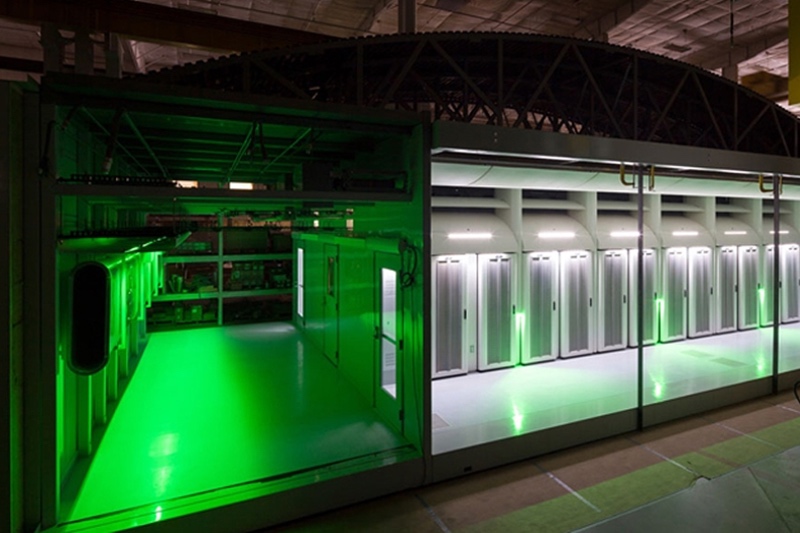
Top image: The TELUS Super Internet Data Center: The innovative modular unit called eComb, utilises a state-of-the-art, patented, closely coupled mechanical design that provides a significant improvement in the system’s overall operating efficiencies


