
The drying stage of active pharmaceutical ingredient (API) production is often the step that follows solid-liquid separation and is one of the most technically demanding. It often becomes a manufacturing bottleneck due to its complexity and the sensitivity of pharmaceutical materials, even when carried out with a purpose-built drying system like an agitated nutsche filter dryer (ANFD). But vacuum drying needn’t pose obstructions. Engineering a vacuum drying cycle that considers thermal dynamics, fluid mechanics, and material science can create robust, reproducible drying cycles. Achieving an effective cycle is about balance, managing agitation, geometry, and pressure to maximise drying efficiency while protecting product quality.
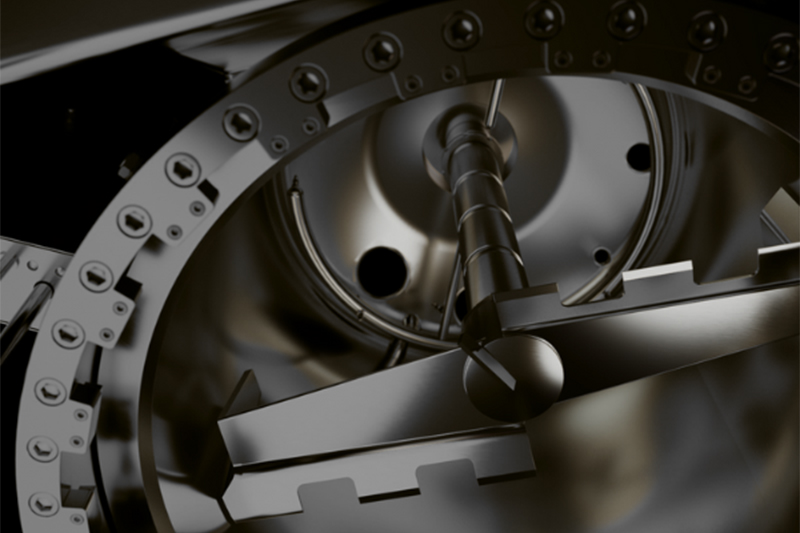
Vacuum drying cycle - agitator
1. Mastering heat transfer dynamics
The primary goal of vacuum contact drying is to maximise heat transfer efficiency from heated surfaces, the vessel jacket and the agitator, into the wet cake. Rates of drying depend on the overall heat transfer coefficient; influenced by both material and equipment parameters.
Conduction is the dominant mode of thermal transfer in most agitated nutsche filter dryer systems. Heat must pass through several resistances: the vessel wall, the bed of wet solids, and the interface where the cake contacts the wall. Any inefficiency at these layers prolongs the drying cycle.
Agitation is key in mitigating heat transfer resistances. By continuously renewing the contact between hot surfaces and moist material, agitation prevents the formation of temperature and moisture gradients within the cake. The process is often modelled using the aptly named penetration model, which simplifies mixing into a series of static phases interrupted by instantaneous redistribution; a framework that helps predict drying rates more accurately (1)
2. The influence of physical geometry: cake height and agitator design
The geometry of the drying bed, particularly cake height, has a profound impact on drying performance and scalability. Taller beds increase resistance to vapour flow, requiring higher pressure differentials for the same drying rate. Conversely, thinner cakes shorten drying times but may complicate handling or product recovery (2)
Equally important is the agitator configuration.
In agitated nutsche filter dryers, the impeller diameter typically approaches the vessel’s internal diameter. The agitator’s stroke, blade design, and rotation direction are tailored to the material’s rheology. These parameters dictate how effectively the agitator redistributes the cake and exposes new wet surfaces to heat.
Agitator speed or rotational frequency directly influences the mixing number (Nmix) in penetration-based drying models. Increasing speed enhances particle motion and promotes faster drying, but this must be balanced against potential mechanical stress on the particles (1)
Learn more: how an agitated nutsche filter dryer works
3. Optimising agitation: speed, intermittency and the “sticky point”
While agitation accelerates heat transfer, over-mixing can damage the product. Excessive shear leads to attrition (particle breakage), whereas premature agitation can cause agglomeration; the formation of unwanted lumps that hinder downstream processing.
An important operational concept in vacuum drying is the critical moisture content (CMC), often referred to as the “sticky point”. This is the solvent concentration where capillary bridges between particles create adhesive forces. Agitating before the cake passes this threshold can cement particles together upon drying (2)
Monitoring torque or cake temperature during operation helps identify the sticky point in real time, enabling automated control responses in advanced agitated nutsche filter dryer systems.
4. Leveraging vacuum and temperature control
Solvents evaporate at significantly lower temperatures under vacuum, an important advantage for heat-sensitive APIs. By tuning the headspace pressure, engineers can set the evaporation point to match the product’s stability profile.
During early drying phases, the solid temperature remains near the saturation temperature corresponding to the pressure inside the vessel. As drying progresses and the solvent content falls, temperature rises gradually, marking the transition to the falling rate period, where internal diffusion becomes the limiting step.
The vacuum level also affects the heat transfer coefficient between the wall and the first solid layer (hws). This relationship depends on the mean free path (lmf) of the inert gas (usually nitrogen) in the vessel. At very low pressures, the reduced gas density increases the thermal resistance of the gas gap, an often overlooked factor that can slow drying if not compensated for by higher jacket temperatures or optimised agitation patterns (3)
5. Integrating process understanding
Designing an efficient vacuum drying cycle means orchestrating several variables simultaneously, heat input, pressure control, and mechanical mixing, all tuned to the material’s thermal and physical characteristics.
A well-engineered process should:
- Maximise conductive and convective heat transfer.
- Prevent particle agglomeration above the critical solvent content.
- Preserve critical quality attributes (CQAs) such as particle size, morphology, and purity.
- Enable reproducible scale-up through precise control of cake geometry and agitation dynamics.
- At Powder Systems Ltd, our Centre of Process Excellence (C.O.P.E.™) combines pilot-scale testing, and advanced control strategies to help customers achieve these outcomes. By analysing drying behavior and mechanical performance under pilot-scale conditions, C.O.P.E™ helps develop optimised agitated nutsche filter drying processes that maintain product integrity while reducing cycle time.
Perfecting a vacuum drying cycle is not simply about reaching dryness, it is about understanding how heat, motion, and material behaviour interact under vacuum conditions. Through decades of process expertise and innovation, we continue to engineer agitated nutsche filter dryer solutions that bring predictability, scalability, and performance to pharmaceutical drying.
For tailored support in optimising your solid-liquid separation or vacuum drying process, contact our team to explore how C.O.P.E.™ can accelerate your process development.
References
- Li, Wei. Drying of Pharmaceutical Powders Using An Agitated Filter Dryer. The University of Leeds. Institute of Particle Science and Engineering. 2014.
- Birch, M, Marziano, I. Understanding and Avoidance of Agglomeration During Drying Processes: A Case Study. Pfizer Worldwide Research & Development.
- K. Nere, Nandkishor, et al. Drying Process Optimization for an API Solvate Using Heat Transfer Model of an Agitated Filter Dryer. Process Research and Development, Global Pharmaceutical Research and Development, Abbott Laboratories. 2012.