Within the pharmaceutical industry, this includes the routine monitoring of active pharmaceutical ingredients (APIs), relevant excipients and surrogate materials through air filter sampling and surface swabbing. Samples are analysed against established occupational exposure limits (OELs) using validated, highly sensitive, robust analytical methods to assess operator exposure and verify the effectiveness of exposure controls.
Cormica specialises in the development, validation and deployment of analytical methods for monitoring occupational exposure to pharmaceutical APIs in manufacturing, clinical and laboratory environments. Our expertise supports clients in protecting employee health, demonstrating the effectiveness of engineering and procedural controls, and maintaining compliance with applicable regulatory requirements and industry guidance.
1) Cormica’s approach
Pharmaceutical environments require a more rigorous approach than generic COSHH compliance alone. Occupational hygiene programmes should be underpinned by risk assessments aligned with GMP/GXP principles, occupational exposure banding frameworks, containment strategies and robust, documented justification of exposure control measures. This integrated approach helps ensure both regulatory compliance and the safe manufacture and handling of pharmaceutical products.
Establishing an occupational hygiene monitoring programme is a complex, multi-faceted undertaking. Our holistic OH package guides you through every step, including the development and validation of analytical methods for multiple active ingredient types (hormones, cytotoxics, antibiotics and controlled drug substances):
- Support in OH risk assessment, limit setting, sampling/testing protocols
- Sensitive analytical methods suitable for multiple analytes, meeting the growing demand for particularly challenging OEL/reporting limits
- Preparation and supply of media (swabs, filters and pre-loaded IOM cassettes); training your staff in effective sampling techniques
- Routine analysis of samples with fast turnaround times
- Analytical method development, validation and testing of proprietary APIs, as well as surrogate API materials such as lactose, mannitol and naproxen sodium
The process is typically broken down into the following steps:
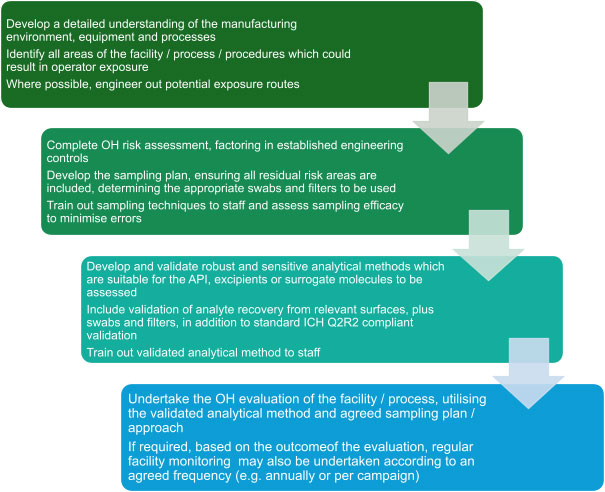
Figure 1: Occupational Hygiene Workflow
2) Why and how do we swab?
Surface swabbing, along with air sampling, is the preferred method for monitoring the presence of potentially hazardous species within the manufacturing environment for both occupational hygiene and cleaning validation/verification. Potential contaminants are recovered by swabbing, eluted from the swab using a carefully selected diluent, and then tested down to trace levels. As a result, the selection of a high-quality swab and the development of a validated detection method (e.g. HPLC-UV, LC-MS, TOC, ICP-MS) are critical to producing sensitive, accurate and repeatable results.
Swabs must offer:
- Minimal extractable interferences
- High analyte recovery rates
- Ultra-low particle/fibre generation
They should be compatible with the desired swabbing diluent and the chosen analytical technique, which in turn should be suitable for the surfaces being swabbed and the analyte to be recovered. It is also very important to include field blank swab and air filter sampling as controls.
It should be noted that recovery rates are a function of the swabbing methodology, as well as the material absorption and residue-releasing attributes of the swab. The effective use of a robust swabbing pattern is critical to ensure accurate and reproducible collection of residues.
An example of a recommended swabbing pattern, employing two swabs, is shown below. Once the surface has been swabbed, the used swab heads should be promptly placed in the extraction solvent, according to the validated procedure.
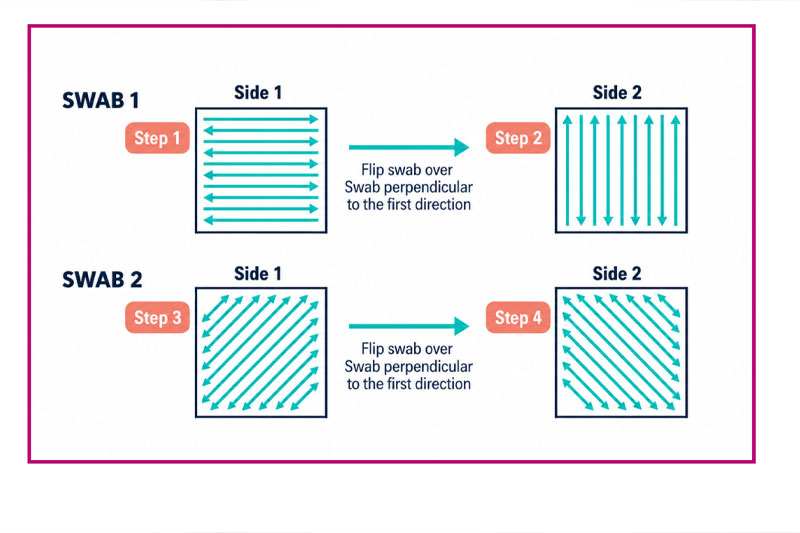
Figure 2: Swab sampling pattern
3) Why use a surrogate?
A surrogate is a low-toxicity material that can replace an active pharmaceutical ingredient (API) when the use of the API is not advisable due to safety concerns. Surrogates are used to simulate potential emissions or sampling for analytical methods, ensuring compliance with safety regulations. They are essential for assessing workplace exposure to hazardous substances and maintaining a safe working environment.
The use of a surrogate is common when performing both cleaning validation and occupational hygiene studies. In a multi-product site, such as one operated by a CDMO (Contract Development and Manufacturing Organization), it may not be possible to know or predict the worst-case scenario API with which to undertake the OH evaluation. Also, the API may be in short supply, expensive or highly potent. In these cases, it is possible to justify the use of a surrogate API.
Naproxen sodium is a common surrogate used throughout the industry. It is regarded as safe and non-potent, has good detectability using UV and fluorescence detectors, demonstrates a high level of dustiness, which is required for occupational hygiene studies, and is inexpensive and readily available.
An additional advantage of using a surrogate for this purpose is that a single validated analytical procedure can be applied to multiple manufacturing and sampling scenarios, with relatively minor additional development and validation required to take account of the specific facility or process being evaluated (e.g. bespoke surfaces).
4) Naproxen sodium methodology
Cormica’s in-house naproxen sodium method has been developed to offer excellent sensitivity, linear range and run time/efficiency (see Table 1) for testing both swabs and air filters. The method can be adapted to your specific requirements, and Cormica can work with you to determine carryover limits if these are not already known. Swab recovery factors can be determined for your specific surfaces and used for your occupational hygiene or cleaning validation study.
The linearity and sensitivity are well established for this method; hence, only minimal additional validation would be required to support the bespoke aspects of your study.
| Parameter | Values |
|---|---|
| Detection method | Ultraviolet (UV); fluorescence (FLD) |
| Linear range (UV) | 76 µg/mL to 399 µg/mL, r² = 0.9994 |
| Linear range (FLD) | 0.00004 µg/mL to 0.004024 µg/mL, r² = 0.9994 |
| Sensitivity (UV) | LOD 9.8 µg/mL (19.6 µg/swab), LOQ 33 µg/mL (66 µg/swab) |
| Sensitivity (FLD) | LOD 0.00004 µg/mL (80 picograms/filter), LOQ 0.00014 µg/mL (280 picograms/filter) |
| Reporting limit (UV) | 33 µg/100 cm² |
| Reporting limit (FLD) | 280 picograms/filter |
| Run time | 5 minutes |
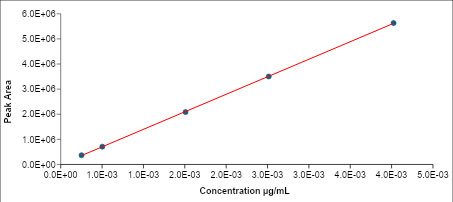
Figure 3: In-house naproxen HPLC method – linear range
Naproxen sodium is a highly suitable surrogate for manufacturing support studies where the assessment of a product-specific API is not practical. In addition to in-house, validated methods for mannitol and lactose, Cormica has developed and validated a sensitive, efficient and cost-effective method for the quantification of naproxen sodium in support of occupational hygiene and cleaning validations.
Where the use of a surrogate such as naproxen sodium is not appropriate or not desired, Cormica can also support clients with bespoke analytical methods for their specific API or group of APIs. With detection capabilities such as UV, FLD, MS, MS/MS and CAD, we can provide support even where sensitivity and specificity are challenging.