

The internet is overflowing with advertisements and catchy claims:
- An air shower is a highly effective means of removing particles from human clothing.
- Air showers meet the stringent ISO and GMP requirements (despite the fact that these documents make no mention of air showering).
- Air showers for cleanrooms are high-efficiency entry systems designed to remove particulate contamination from personnel, etc.
- But what’s the reality? Is an air shower truly effective, or is it just another way to deceive the unsuspecting, a shameless way to profit from people’s gullibility and incompetence?
What is an air shower?
An air shower is located at the entrance to a cleanroom. It can be designed as a chamber or a tunnel that is equipped with nozzles that spray jets of air onto the person, similar to the hydrotherapy Charcot shower. The air speed in these jets can reach 30 m/s.
Importantly, do not confuse an “air shower” with an “air lock”. An air lock does not include a blow-off function, but an air shower chamber or a tunnel is an air lock.
What do air showers promise?
A person wearing cleanroom clothing enters the air shower lock and stands still, raising arms and performing other movements to allow the airflow to reach parts of the clothing.
That’s the idea. But does it work in practice?
Experts have been asking this question for a long time. Studies have appeared in Japan, England, the USA, and other countries. Their conclusion is clear: air showers are ineffective; they create the illusion of usefulness and, therefore, can cause harm. The best proof of effectiveness, or lack thereof, is an experiment.
Some users consider air shower as a substitute for washing clothes
Experimental findings for air shower effectiveness
Studies evaluating the effectiveness of air showers were conducted as early as the 1960s-1990s.
In the 1990s, an experiment was conducted to evaluate the effectiveness of air showers. The results were published in the journal “Microcontamination,” September 1994, in the article “Evaluating the effects of a cleanroom air shower on particle dispersion” by William Whyte and Derek McGeorge. The article is publicly available online.
In this article, it was found that with air velocity from nozzles ranging from 10 to 30 m/s, the removal efficiency for particles sized 5, 10, and 30 µm is 50%, 80%, and 90%, respectively. For particles <2 µm, air showers proved ineffective.
The tests were conducted in an air shower tunnel through which personnel entered the cleanroom.
The tunnel maintained a cleanliness level of Class 100 (ISO Class 5) with air recirculation through HEPA filters. The air flow velocity was 14 m/s. The tunnel’s special design ensured very high air turbulence and airflow across all areas of clothing.
Cleanroom clothing was an important part of the experiment. The garments themselves have been shown to emit few particles. The majority of particles are emitted by human skin and underwear, penetrating into the environment at the ankles, cuffs, and neck.
The test person in the 1994 study wore a one-piece coverall, knee-length boots, face mask and full hood.
Tests were conducted in two scenarios:
- The subject entered the cleanroom through the airlock after a full airflow cycle.
- Bypassing the airlock.
After the air shower, the volunteer in cleanroom clothing entered a test chamber with HEPA filters installed in the ceiling and a particle counter sampler in the exhaust. The test results are shown in the Table 1.
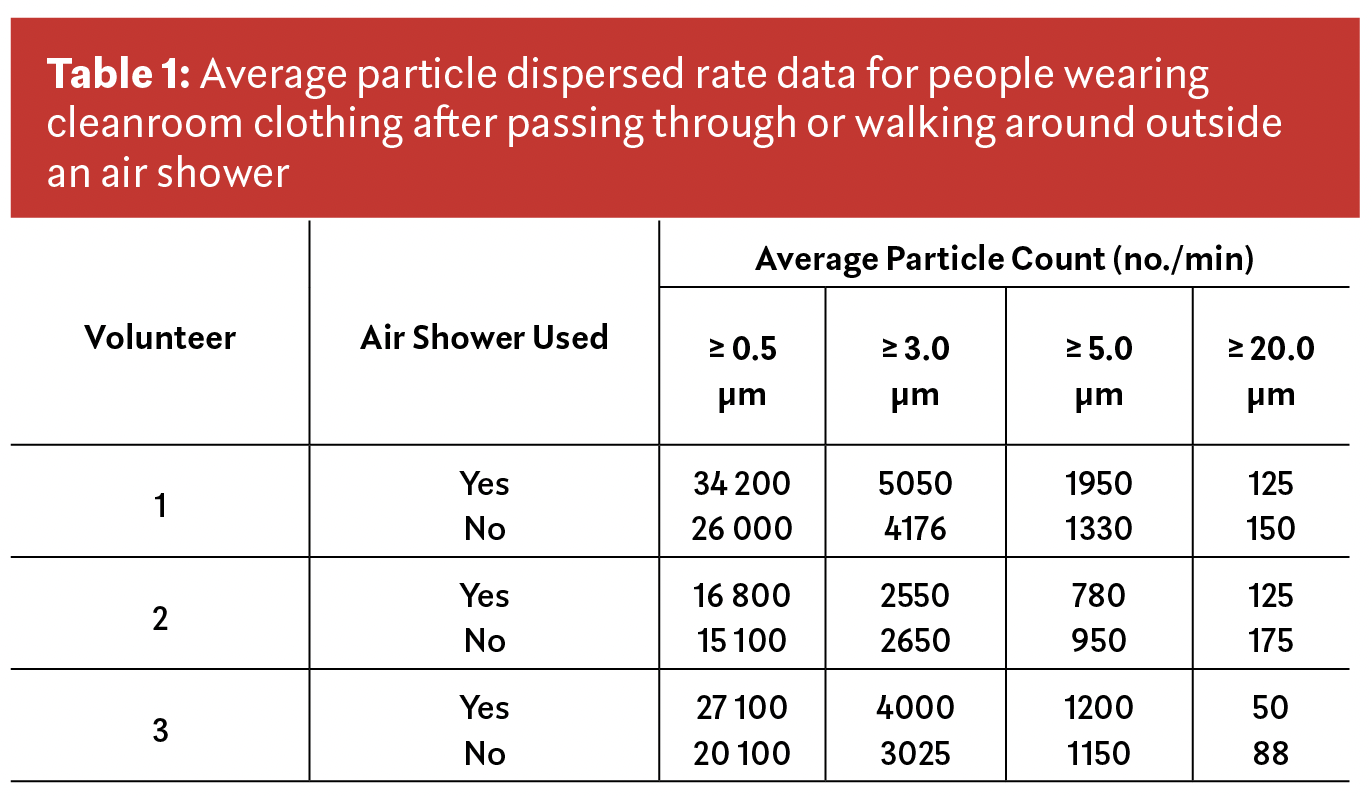
Particle dispersion from people
Table 1 shows the airflow efficiency when comparing the particle emission rates of three volunteers passing through the air shower and bypassing it. Each result is the average of 10 tests.
The comparison shows the ineffectiveness of the airflow.
The cleanroom particle count: Table 2 shows the effect of air shower flow on airborne particle counts in a Class 100 (ISO Class 5) cleanroom. These results were obtained by averaging 128 counts for four particle sizes after passing through and bypassing the airflow lock.
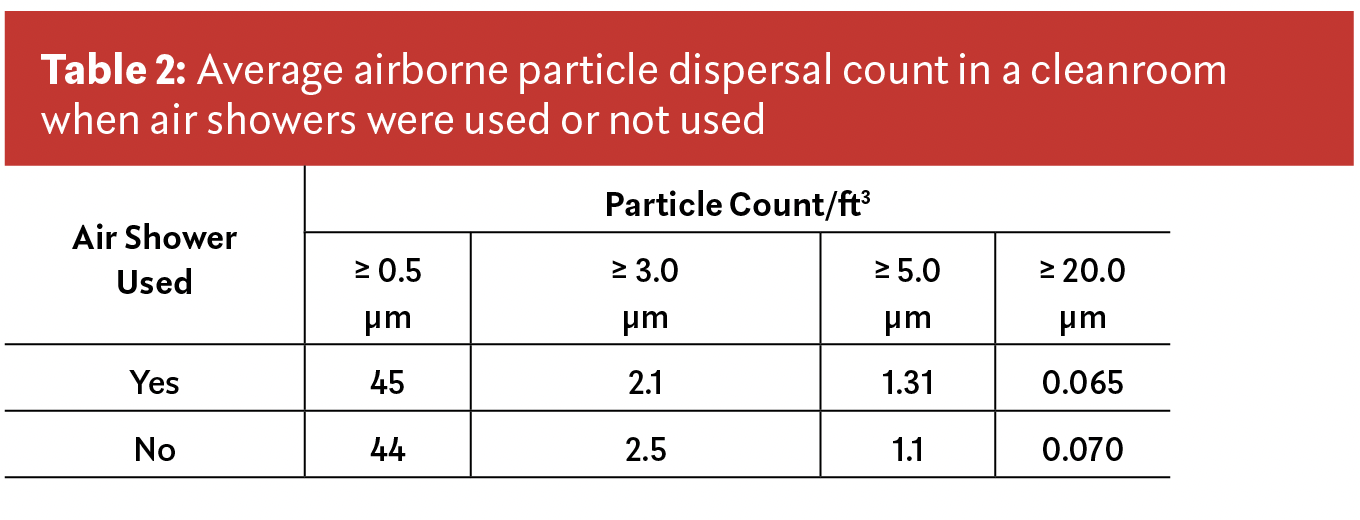
There is no meaningful difference between the counts taken in the cleanroom where air shower was used and where it was bypassed. Therefore, the ineffectiveness of airflow has been illustrated.
A factor that may distort the picture is that the air shower flow barrier is an airlock. The effect of separating different cleanliness zones using an air shower barrier could be attributed to the air shower.
To rule this out, a simple experiment was conducted: a person first entered the cleanroom through the airflow barrier, and then through a bypass. It was shown that air shower barriers had no effect.
Substitution of concepts
Some users consider air shower as a substitute for washing clothes. It is very tempting not to set up a laundry (a separate area for washing clothes) or send clothes for processing to a specialised company with cleanrooms, equipment, qualified personnel, and processing technology.
It’s much simpler to install the air shower and to forget about the problem.This was observed in practice. At one large facility, a cleanroom engineer declared that there was no need to wash clothes as an air shower
would replace it. To check it a simple shaking of the clothes in a cleanroom after passing the air shower was done. This revealed that they were releasing a significant amount of particles, with the counter literally going off the charts.
Injury risk
Though there is little to no evidence of a beneficial effect of air showers, it could be easy to think there is no harm in them. However, the air jet velocity at the nozzle exit reaches 30 m/s, to supposedly ensure effective blasting.
But what about human safety? The threshold values for atmospheric air velocity and the associated damage and hazard to humans are listed below.
Atmospheric air velocity thresholds:
- 10.8–13.8 m/s (Beaufort Force 7–8): Thick branches sway, making it difficult to walk against the wind.
- 13.9–20.7 m/s (Beaufort Force 8–9): Tree branches break, causing damage to buildings (roofs torn off).
- > 20 m/s: Considered hurricane-force, capable of tearing off trees, destroying buildings, and posing a direct threat to human life.
There’s a claim that the airflow velocity decreases as it reaches an object (a clothed person) and that this is safe. However, if the velocity decreases significantly, the airflow will be weak. If the velocity remains high, it’s dangerous.
A human being isn’t a machine or a precision mechanism. Part of their body, including their head, eyes, and ears, even if covered, can end up near the airflow nozzle. There’s a clear risk of injury. Has anyone assessed the danger to humans in various positions, including touching or being near the airflow nozzles in the airflow lock?
There’s a lot of speculation about this, especially in the pseudo-scientific community, where the people involved have never been held accountable for anything and are unlikely to have ever tried to understand what they do.
The real responsibility lies with the user companies, and within them, the chief engineer. They are responsible for safety, and they must understand the consequences of their decisions. Has anyone received a conclusion from the sanitary and healthcare safety supervision (consumer protection) authorities regarding the permissibility of airflow locks?
Head, eyes, and ears, even if covered, can end up near the airflow nozzle
Why are airlocks so widespread?
There are two main reasons:
- Many companies have mastered the production of airlocks, and these companies mislead users by advertising non-existent effectiveness. They don’t provide efficacy test results. Cannot be accepted.
- This approach finds fertile ground, superficial users who don’t want to do the real work and instead accept easy solutions: there’s no need to do anything, it’s better to buy an indulgence, an air shower.
Conclusions
- Air showers can remove particles from the surface of clothing, but only large particles exceeding cleanroom standards. They are ineffective against small particles.
- After proper laundering in cleanrooms, polyester clothing is almost particle-free.
- Only a small percentage of particles are released from the surface of clothing. The majority of particles are released from the skin and underwear.
- Air shower removes only a small number of particles, and air blowing has no effect on the particle concentration in the cleanroom.
- The use of air showers creates the false impression that clothing does not need to be washed or can be washed only through a simplified process.
- High air velocities in the air shower are dangerous to humans.
- And, finally, cleanroom users shall wash (sterilise) multi-use clothing or use approved single use clothing, follow well established practices and never replace them by ineffective simplification.
Author details:
Alexander Fedotov Director Clean Technologies


