
Microsphere drug delivery systems demand a sterile environment throughout every stage of the manufacturing process. Aseptic processing operations preserve the integrity of polymeric microspheres, ensuring each sterile product meets the requirements for sustained release and batch reproducibility. This level of control is particularly important when working with sensitive microsphere formulations that cannot tolerate terminal sterilisation.
From microsphere production through to sterile packaging, aseptic processing protects the drug product and enables reliable commercial-scale manufacture. Here is how modern processing systems uphold the quality and consistency advanced drug delivery systems require.
What is aseptic processing?
Aseptic processing is a pharmaceutical manufacturing approach in which components such as active pharmaceutical ingredients, excipients, containers and closures are brought together in a sterile environment. Unlike terminal sterilisation, which exposes a sealed product to high heat or radiation, aseptic processing avoids harsh post-manufacturing conditions altogether. This makes it essential for heat-sensitive materials and biologics that would otherwise degrade.
Maintaining sterility relies on several key principles:
Sterile inputs: all materials are sterilised in advance using filtration, steam or irradiation.
Controlled environments: manufacturing takes place in cleanrooms, typically ISO 5 or better, with HEPA-filtered airflow to minimise airborne contamination.
Closed systems: materials are transferred using sterile connections or barrier isolators to prevent exposure.
Validated procedures: each step, from filtration to filling, is rigorously validated, often through media-fill trials that simulate worst-case conditions.
Environmental monitoring: routine microbiological and particle monitoring of air, surfaces and operators ensures continued compliance with regulatory limits.
These requirements are embedded in global regulatory frameworks including FDA cGMP (21 CFR 210/211), EU GMP Annex 1 — recently updated to remove ambiguity in interpretation — and PIC/S guidelines. All place sterility assurance at the centre of aseptic manufacture.
Microspheres: why they're unique
Microspheres are polymer-based carriers designed to deliver drugs over extended periods. Often only a few microns in diameter, they encapsulate or disperse active compounds within a biodegradable matrix, most commonly PLGA (poly(lactic-co-glycolic acid)). As the polymer degrades, the drug is released in a controlled manner.
Their applications span a wide range of therapies, including:
- long-acting injectables for hormones, antipsychotics and peptides
- targeted drug delivery, including tumour-specific formulations
- vaccine and biologic platforms requiring sustained antigen release
- ocular implants and tissue engineering scaffolds
These applications rely on exceptionally high purity and sterility, particularly as microspheres are frequently used in injectable or implantable products.
Why sterility is non-negotiable
Contamination in microsphere products can have serious clinical consequences, ranging from localised infections to systemic sepsis. At the same time, many microsphere formulations incorporate labile biologics or sensitive APIs that cannot withstand terminal sterilisation. As a result, aseptic manufacture is not simply preferable — it is the only viable option.
Effective sterility control depends on:
- sterile raw materials and intermediates throughout the process
- strict cleanroom discipline, including gowning procedures, airlocks and pressure differentials
- barrier isolators or restricted access barrier systems (RABS) to minimise operator intervention during critical steps such as filling and sampling
- automated, closed processing systems that eliminate open handling and reduce contamination risk
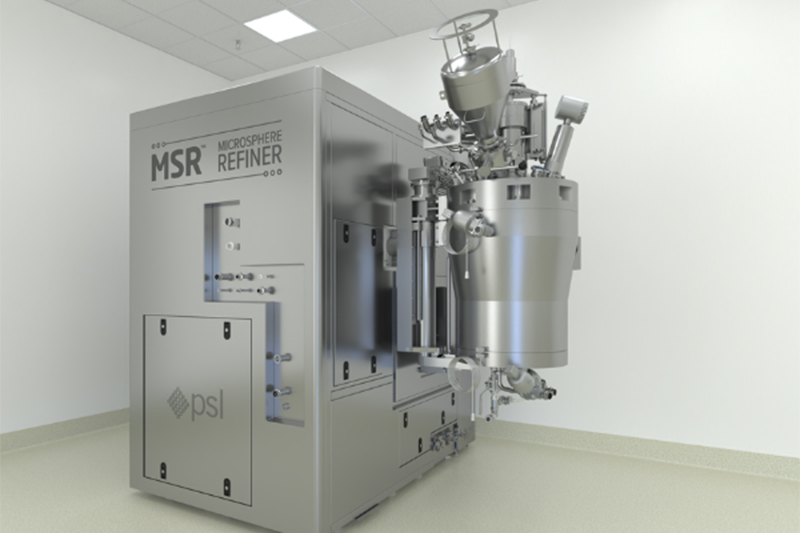
This is where specialised equipment such as Powder Systems Limited’s MSR™ microsphere refiner plays a critical role.
The MSR™ advantage: integrated aseptic microsphere processing
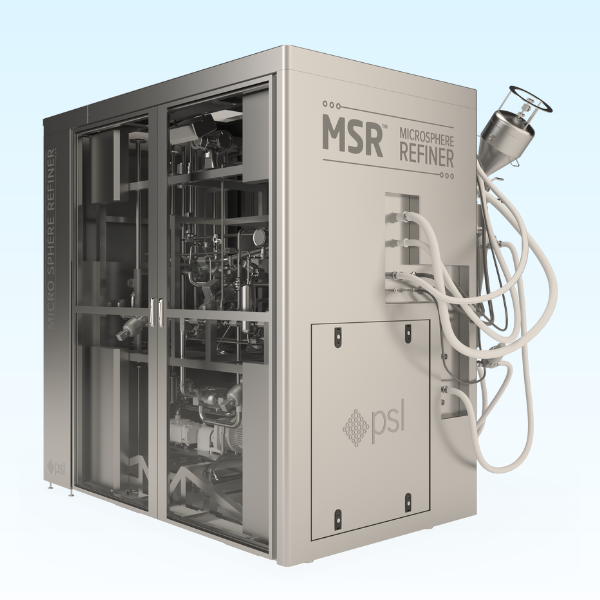
PSL’s MSR™ microsphere refiner supports sterile microsphere manufacture by integrating classification, washing, drying, sampling and final discharge within a single closed and automated system. It is purpose-built to address the specific challenges of aseptic microsphere production.
Key benefits include:
- All-in-one processing: solvent removal, filtration and lyophilisation are performed within a single sterile vessel.
- Full automation: manual offloading is eliminated, reducing one of the highest contamination risks.
- Scalable technology: the same platform is available for both R&D (LabMSR™) and commercial production, supporting consistent scale-up.
- Regulatory readiness: the system is engineered to support compliance with global regulatory standards.
By maintaining a closed process from start to finish, the MSR™ system improves sterility assurance while also increasing operational efficiency.
Looking for a microsphere refining solution?
Microspheres offer significant potential for targeted, controlled and long-acting therapies. Realising this potential depends on maintaining sterility at every stage of manufacture — something only robust aseptic processing can deliver.
Technologies such as PSL’s MSR™ microsphere refiner provide an integrated and validated platform aligned with current regulatory expectations, while actively reducing contamination risk. The result is improved product quality, enhanced patient safety and a smoother transition from laboratory development to commercial manufacture.
As demand for microsphere-based formulations continues to grow, investment in reliable aseptic manufacturing solutions is becoming increasingly critical.