
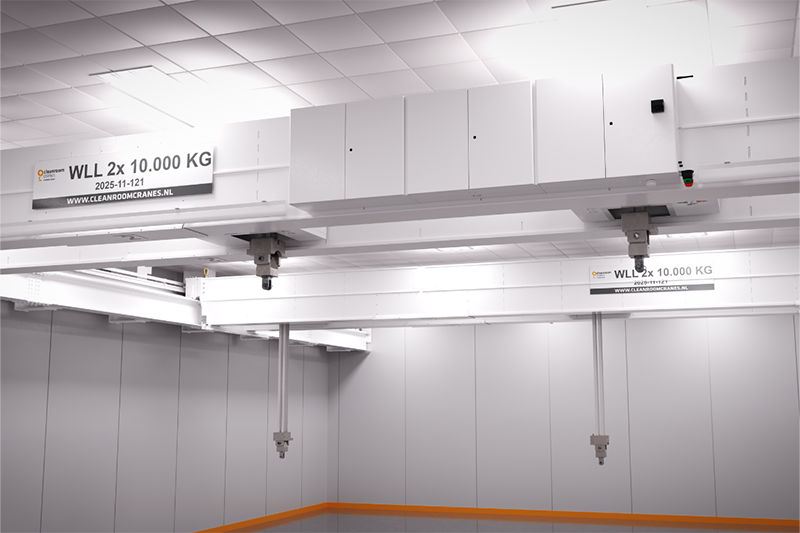
Ask when an overhead crane is selected during a cleanroom project and the answer is often straightforward: once the production layout has been defined.
It sounds logical.
Yet many of the decisions that influence the lifting system have already been made by then. Structural design, available headroom, equipment layouts and maintenance requirements all determine how effectively overhead lifting can be integrated into the facility.
The question is therefore not when a crane is selected, but when its performance is being designed.
Early design choices shape the lifting system
An overhead lifting system is never an isolated piece of equipment. Its design depends on the building structure, available headroom, surrounding process equipment and maintenance requirements. Together, these factors define the available design options.
As a project progresses, design flexibility naturally decreases. That rarely creates immediate challenges during commissioning. The real impact often appears years later, when equipment is replaced, production processes change or larger assemblies need to be handled.
When lifting requirements are considered early, the lifting system can be integrated into the cleanroom design instead of being adapted to it.
A crane does more than move a load
Load capacity, span and lifting height are often the starting point when specifying a cleanroom crane.
They remain essential.
In a cleanroom, however, they represent only part of the design challenge.
The lifting system also influences how production equipment is installed, maintained, upgraded and eventually replaced. Something as simple as replacing a process tool or handling a larger assembly years later may be influenced by design decisions made during the early stages of the project.
In other words, overhead lifting supports much more than the movement of a load. It becomes part of the production environment itself.
As cleanroom manufacturing continues to evolve, these broader design considerations become just as important as the technical specifications of the crane.
Today's decisions affect tomorrow's flexibility
Cleanrooms are designed for long operational lifecycles. During that time, production processes evolve, equipment is upgraded and new product generations introduce different handling requirements.
This is when early design decisions begin to show their value.
A lifting system that has been considered alongside structural design, process layouts and maintenance strategies is generally better prepared to support future changes. Accessibility is improved, maintenance becomes easier and the production environment remains more adaptable as operational requirements evolve.
These benefits are rarely visible on the day a facility is commissioned. They become apparent over years of operation.
From lifting equipment to engineering discipline
The role of overhead lifting within advanced cleanroom facilities continues to evolve.
Rather than treating lifting systems as standalone equipment, more organisations are integrating them into the wider design process. Structural engineering, production layouts and maintenance strategies are increasingly considered together while there is still sufficient flexibility to optimise the overall solution.
The result is more than a crane that simply fits the available space. It is a cleanroom lifting solution that supports the long-term performance, adaptability and maintainability of the production environment.
Looking beyond today's project
Every cleanroom is designed to support reliable production today while remaining flexible enough to meet tomorrow's requirements.
The same principle applies to overhead lifting.
Many of the decisions that determine long-term lifting performance are made long before the crane itself is selected. Considering lifting requirements early helps preserve valuable design flexibility and creates opportunities that become increasingly difficult to recover as a project moves forward.
The discussion is therefore no longer about whether overhead lifting should be part of a cleanroom project. Increasingly, the question is how early it should become part of the engineering process.
At Mennens Cleanroom Cranes, the company approaches cleanroom crane design as an integral part of cleanroom engineering. This approach enables project teams to consider lifting requirements while key design decisions are still being made. The result is a lifting solution that supports reliable operation today while remaining adaptable to future production requirements.


