
Maintaining the highest standards of cleanliness in cleanrooms is crucial for industries ranging from pharmaceuticals to food production and semiconductor manufacturing. The challenges involved are far more complex than following protocols, as even the smallest contamination can compromise product integrity. Strict regulations, pathogen risks, continuous monitoring, minimising human error, staff shortages, and reducing downtime are some of the ongoing challenges.
So how can organisations optimise their cleaning strategies while ensuring compliance? Technology, covering everything from data-driven cleaning to smart ergonomic equipment, is redefining safe and efficient operations.
Reducing downtime and operational costs
When contamination issues occur, production temporarily comes to a halt, which can cost tens of thousands of pounds for a large, complex cleanroom. This is one of the biggest challenges and a key reason to opt for more efficient cleaning solutions. By using efficient cleaning methods and mechanical solutions, production can restart faster, saving significant overhead.
Cleaning teams play a vital role in minimising downtime, following strict protocols. Integrating advanced training programmes, such as virtual reality (VR) simulations, helps employees to practice correct cleaning techniques in a controlled environment. Additionally, smart ergonomic tools with built-in guidance systems help reduce user error. In some high-tech cleanrooms, automated systems provide real-time feedback on cleaning performance, ensuring that no critical areas are overlooked.
Proactively navigate protocols
Airborne particle contamination is a challenge for every cleanroom. ISO 14644, the cornerstone of cleanroom standards, specifies the classification of air cleanliness in terms of concentration of airborne particles.
Each ISO classification allows a certain maximum number of particles per cubic metre of air. This, along with additional protocols, including Good Manufacturing Practice (GMP), ensures that contamination control, stringent cleaning processes, and verification procedures are adhered to. However, compliance is more complex and goes beyond following these cleanroom standards. Organisations should adopt a proactive approach by implementing real-time monitoring systems and standardised cleaning processes. Emerging trends, such as automated validation and digital documentation, help facilities stay ahead of evolving regulations. For example, some manufacturers are now integrating real-time particle counting into their cleaning workflows to ensure continuous compliance with ISO classifications.
Minimise inconsistency
In an already challenging environment, cleaning equipment should be designed to make processes easier. Traditional cleanroom floor cleaning relies heavily on manual wiping and mopping, which can be time-consuming, physically demanding and inconsistent. This also increases the risk of cross-contamination, leading to extended downtime and production delays.
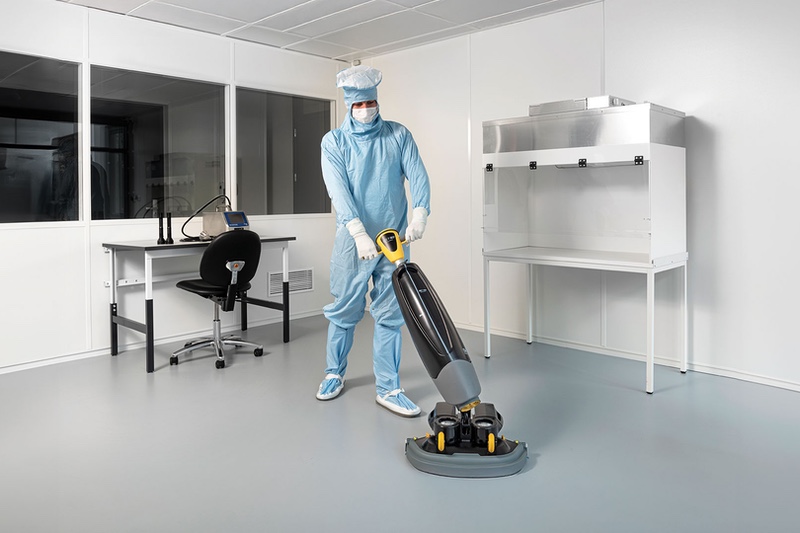
That’s why my organisation, i-team Global, recently introduced the SAFE-T product family, the world’s first battery-powered cleanroom floor cleaning range. Each machine is designed specifically for cleanroom settings, and the exhaust output is certified to the rigorous ISO standards for these controlled environments. Powerful mechanical scrubbing and Ultra-Low Particulate Air (ULPA 15) filtration help to remove more embedded particles than manual methods, capturing over 99.999% of contaminants as small as 0.1 microns.
Lightweight, battery-powered machines with ergonomic features and intuitive controls improve both comfort and efficiency. These sustainable products also eliminate single-use mop waste, as well as water and cleaning agents. They also contribute to more efficient workflows by eliminating the setup time in dealing with floor cables or searching for a power socket.
Faster charging time is also important. Some machines include built-in non-removable batteries that are charged by plugging a cord into a wall socket. This means when the battery runs out, you have to bring it to the wall, plug it in, and then wait for a long time until it’s fully charged. By using cleaning machines with swappable batteries, you have instant, continuous use. Meanwhile, the removed battery can be recharged at the same time.
Preventing cross-contamination
Cross-contamination is a critical concern, particularly in high-traffic areas such as gowning rooms and airlocks. Research shows that floors in these zones are often the most contaminated surfaces in cleanrooms, yet they are sometimes overlooked in contamination control strategies.
To keep your cleanroom operating at its best, start with clear zone-based cleaning routines, using dedicated equipment for every space. In transition areas, automatic disinfection tools provide extra protection, and upgrading your filtration systems helps to reduce the risk of airborne contaminants.
Regular maintenance, like filter changes and plant checks, makes a big difference too. Many organisations are now going a step further with antimicrobial coatings and UV-C disinfection tunnels to add even more layers of safety.
Risks from human presence
Studies indicate that human activity accounts for approximately 80% of cleanroom contamination, so removing dust, airborne particles and other particulates from personnel before they enter the cleanroom is vital. Implementing automatic disinfection technologies in transition areas such as entryways and changing rooms significantly reduces the potential for contamination. Measures such as air showers and sticky mats help remove particles from personnel before they enter the cleanroom.
The fewer people you have in controlled environments, for example, to clean the area, the less risk of contamination. Automated cleaning solutions specifically designed for cleanrooms can help tackle contamination with efficiency and precision. Machinery can be programmed to follow specific cleaning schedules, allowing it to autonomously work at predefined times, ensuring minimal disruption to operations.
Enhanced filtration
Equipment with enhanced filtration systems helps to reduce airborne contaminants. If these particles get into products such as medicine or cosmetics, batches can be compromised. It’s a very serious issue. That’s why our SAFE-T-VAC has a special filtration system, with Ultra-Low Particulate Air (ULPA) filters on both the inlet and outlet and eight total layers of filtration. The cloth dust bag has five layers in itself and features a plastic holder and silicone closure mechanism, to ensure that dust particles don’t escape from the machine. The ULPA 15 filters are cross woven to create a mesh, to ensure exceptional air purity.
Addressing staff shortages and training gaps
Cleanroom facilities worldwide face a shortage of skilled cleaning personnel, a problem compounded by increasing regulatory requirements. High turnover rates further exacerbate the challenge of maintaining a well-trained workforce.
The work involved in cleanroom maintenance is physically demanding and often performed under warm conditions. The tasks must be carried out according to specific protocols, adding another layer of complexity. This situation underscores the importance of investing in staff training and development, as well as creating a work environment that values and supports its employees. By doing so, companies can help ensure they have a reliable, skilled workforce ready to meet the unique demands of cleanroom cleaning. Additionally, exploring technological solutions, such as automation, could also help alleviate some of these challenges. Some companies are investing in digital learning platforms that provide interactive step-by-step guidance, reducing induction time for new employees. Others are exploring collaborative robots (cobots) that assist cleaning teams, ensuring consistency and reducing physical strain.
Future-proof your cleanroom strategies
The cleanroom industry is entering a new era of contamination control. Innovations are helping businesses keep contamination out of critical environments while saving time, reducing costs, and addressing staff shortages. With the integration of automation, real-time monitoring, and smart cleaning strategies, organisations can move beyond basic compliance and set new benchmarks for cleanliness and efficiency.
In the coming years, cleanroom cleaning is set to evolve further with innovations such as AI-driven contamination prediction, fully autonomous cleaning robots, and even self-sanitising surfaces. Organisations that adopt these advancements early will not only maintain compliance but also gain a competitive edge.
Are you ready to future-proof your cleanroom cleaning strategy? Industry leaders are already exploring smarter, more resilient contamination control methods. The key question to adapt to the next generation of cleanroom hygiene.


