Despite the billions pharmaceutical manufacturers are investing in digital and automated systems, environmental monitoring in most sterile facilities still relies on the manual four-eye principle. The analyst counts colonies on a plate and manually enters their count into a laboratory information management system (LIMS). A second analyst then reads the plate, to confirm the count, and the plate is either processed for identification or simply discarded.
However, once the plate is gone, the only record of a colony count is the number someone wrote down and entered into LIMS. If a second reader disagrees with the first, there is no ability to refer to the plate at the point in time the first reader read it. Colony counting can be a judgement call, particularly with spreading or overlapping growth, and two experienced microbiologists will not always land on the same count. While neither is objectively wrong, this still leads to lost time and room for error.
Most of the cost here is hidden and shows up as second reads, quality assurance checking for transcription errors, investigations opened over count discrepancies, deviations when plates are read outside the incubation window, and the scramble when an auditor asks how a result from last year was reached. Variability between analysts can also produce alerts that turn out to be false alarms, further wasting time and resources.
Building data integrity into the workflow
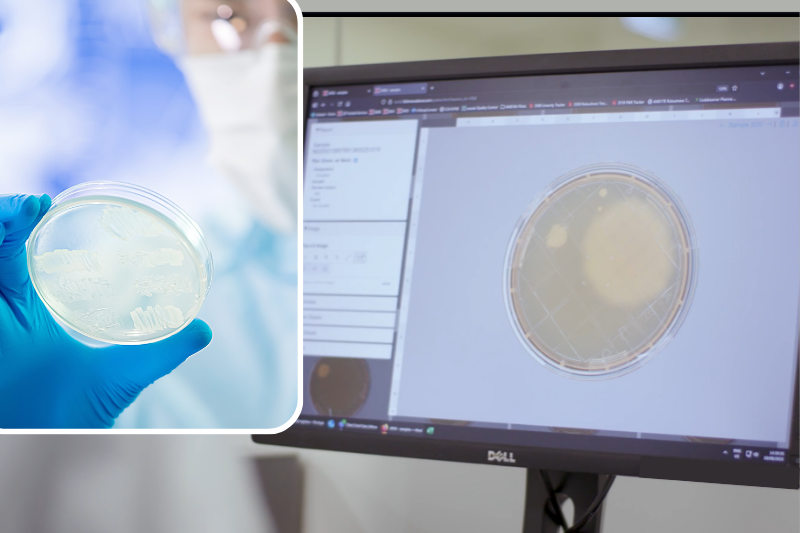
Automated plate reading systems, like APAS® Independence, remove manual steps from the process of plate reading, rather than adding paperwork around them. Each plate is imaged in a controlled environment with consistent lighting. This represents a significant improvement, where an image is captured at the time of reading and is now available for long-term storage, providing an enduring record that outlives the plate. The system also produces reports that cannot be adulterated and incorporates the image with the APAS result. This provides a reference that can be reviewed long after the plate is gone.
The plate read itself is performed by a locked AI algorithm, meaning the same plate gets the same treatment on a Monday morning as it does at the end of a night shift on Friday. Results are transferred directly to LIMS, removing the risk of manual transcription errors. Access to APAS Independence is by individual logins with defined permissions, approvals are electronic, and the audit trail records actions as they happen. This enables analysts to spend their time on flagged plates rather than working through a large volume of negative plates.
Turning guidance and principles into practice
ALCOA+ asks for records that are: Attributable, Legible, Contemporaneous, Original, Accurate, Complete, Consistent, Enduring, and Available. Manual environmental monitoring can meet those principles, but proving it is largely a matter of documentation and records of retention. With automated reading and reporting, the principles of ALCOA+ can be embedded into how the instrument works and is integrated with external systems; the login supplies attribution and non-repudiation, the APAS data is the original record, and the timestamp is applied when the plate is read (contemporaneous), not when someone gets around to the paperwork (see Table 1 below).
Table 1 - APAS Independence Conformance with ALCOA+ Principles Overview
| ALCOA+ Principle | Definition | APAS Independence Conformance |
|---|---|---|
| Attributable | Every action must be traceable to the person, system, or device generating or modifying data. | Assigns individual, role-based user logins with unique credentials. Every plate scan, AI designation, and manual operator override is tagged with a unique user ID, instrument serial number, and timestamp. |
| Legible | Records must remain readable, clear, and permanently accessible throughout their life cycle. | Replaces manual hand-written plate counts with high-resolution digital images, standardised algorithmic classification metadata, and clear, structured digital reports. |
| Contemporaneous | Data must be recorded at the precise time the activity or measurement occurs. | Captures images, analyses plate growth, and logs results in real time during the automated imaging process. Timestamps are generated automatically upon execution. |
| Original | The initial primary record must be preserved intact without replacement or loss. | Saves the raw high-resolution images and APAS result captured at the moment of scanning as the primary source file, preventing overwrites or alterations. |
| Accurate | Data must be precise, error-free, and representative of the observation. | User validated, locked artificial intelligence and machine learning algorithms to eliminate subjective human counting errors and transcription mistakes. |
| Complete | All data and associated metadata must be recorded without omissions. | Maintains an unalterable, tamper-evident audit trail capturing all system events, raw images, analytical outputs. |
| Consistent | Data must follow a chronological, logical sequence and remain unified across system views. | Applies standardised processing rules to every plate and syncs data sequentially with LIMS/electronic systems, ensuring identical record states across platforms. |
| Enduring | Data must be quickly retrievable for review, audit, or inspection whenever needed. | Stores digital plate records, metadata, and audit logs for an extended period of time. |
| Available | Data must be quickly retrievable for review, audit, or inspection whenever needed. | Enables rapid search, filtering, and retrieval of archived plate images and batch reports via the user interface or LIMS integration. |
Annex 1 points the same way, expecting contamination control to rely on timely evidence rather than evidence reassembled afterwards. The purpose is to achieve consistent, timestamped environmental monitoring results that can be analysed by room, grade, or shift, delivering meaningful trends and insights that drive improved manufacturing behaviours. This process is intended to enable good decision making and lay a foundation for the predictive analysis the industry is moving towards.
From results to reliable data
Ultimately, the value behind an AI-enabled automated plate reader like APAS Independence is not simply that it counts plates faster. It enhances the quality of the data behind the testing itself. By creating an enduring, traceable record of what was on each plate after incubation, applying a consistent reading process, and removing manual transcription from the workflow, APAS Independence turns environmental monitoring results from a number that has been recorded into data that can be demonstrated, reviewed, and trusted.
For pharmaceutical manufacturers, that means stronger data integrity, greater consistency, and more defensible records when questions arise. It gives quality control microbiology teams a reliable foundation for data they can trust to identify trends earlier, respond to risks faster, and make more informed decisions.
Learn more about how APAS Independence can streamline your plate reading workflow and strengthen your environmental monitoring program’s consistency, traceability and over all data integrity here.