

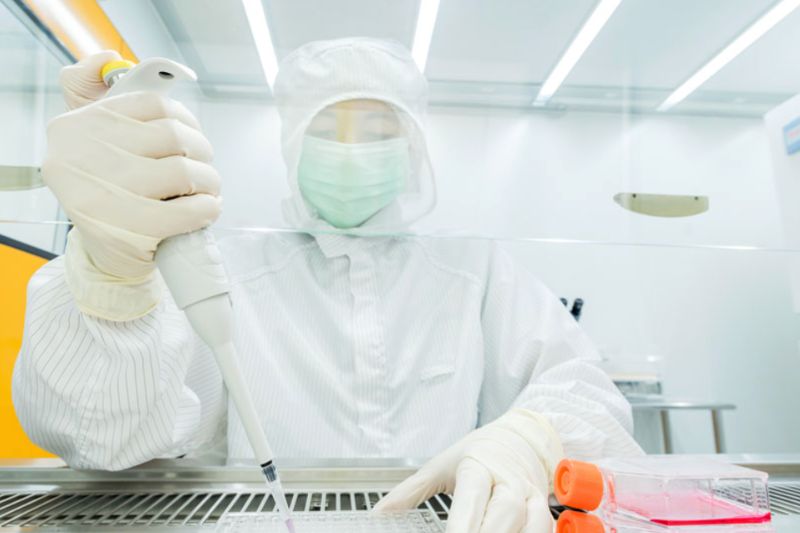
Chrysalis has restructured its 17,500 sqft GMP facility in Boston to create four distinct ISO Class 7 and ISO Class 8 cleanroom suites within its existing footprint.
The redesign of the site, which has been operational since 2018, allows multiple client programmes to run concurrently in segregated environments.
“We prioritised modular cleanroom suites that can accommodate different manufacturing modalities and scale with our clients’ needs,” Adam Bartley, COO of Chrysalis told Building Better Healthcare.
“Companies can start with a single 500 sqft suite and expand across multiple rooms as their programmes scale without major infrastructure changes.”
Central to the reconfiguration is a modular layout designed to align with the development timelines of early- and mid-stage biotech companies, enabling scale-up without major disruption.
The Waltham site provides clients with everything they need to run their own GMP manufacturing, without having to manage the building or infrastructure themselves.
This includes environmental monitoring, materials handling, quality systems, and facility management.
“The space is designed to feel like their own facility, with the flexibility to configure workflows, bring in specialised equipment, and operate on their own timelines,” said Bartley.
How sustainability is baked into the rental model
The four-suite configuration supports Chrysalis’ cleanroom hosting model, where companies rent dedicated GMP space while sharing core infrastructure and operational services.
This model provides an alternative for organisations that need GMP-ready capacity but are not ready to invest in a standalone facility or fully outsource to a CDMO.
“On sustainability, we designed the space to maximise utilisation,” said Bartley. “The Chrysalis Cleanroom Hosting model allows multiple clients to share facility infrastructure and services rather than each building redundant capacity, which is inherently more sustainable than the traditional build-your-own approach.”
The facility also includes card-access client offices, mapped GMP storage, and supporting infrastructure suitable for a wide range of therapeutic modalities.
Break rooms and collaborative spaces
Alongside classified production areas, the facility incorporates non-classified working spaces, including break rooms that also serve as meeting and troubleshooting areas.
“Break rooms serve a dual purpose beyond just breaks,” said Bartley. “They function as working areas where our clients can take meetings, review and update batch records, troubleshoot process issues, and collaborate without disrupting cleanroom operations.”
Positioned in Boston’s biotech hub
Located in the heart of the Greater Boston life sciences cluster, the Waltham site provides access to early- and mid-stage biotechnology companies progressing toward GMP manufacturing.
“Waltham sits right in the heart of the Boston biotech ecosystem, surrounded by some of the most innovative early- and mid-stage companies in the world,” said Bartley.
“This facility plays a critical role in supporting those companies as they transition from preclinical development to GMP manufacturing. Many emerging biotechs don’t have the capital or time to build their own facility, and some aren’t ready to hand over control to a CDMO. [This] bridges that gap.”


