

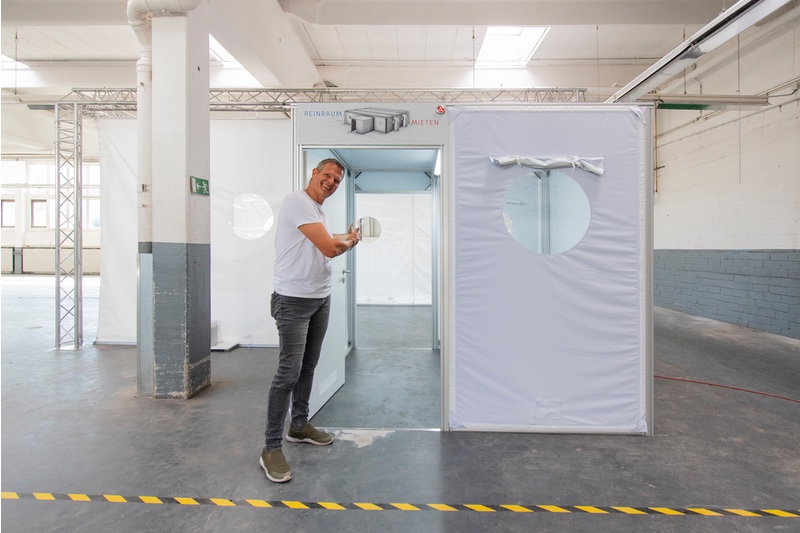
Lives depending on your technology is one of the few aspects that hot air balloons and cleanrooms both must tackle. So, why has Wolfgang Hassa taken his expertise from one into the other, and what has it contributed to the cleanroom industry?
The Germany-based ReinraumZelt (in English, Cleanroom Tent) founder has chartered an untraditional path into the cleanroom and controlled environment sector. In 2020, Hassa’s existing company, Airworxx, encountered issues in the form of the pandemic. The company specialised in airships, hot-air balloons, and large fabric structures for events and advertising. With the live event sector shutting down overnight, having a company that relied heavily on them was a problem.
“Corona destroyed our business completely,” the founder recalls. “Two years with no events meant nobody needed our products.”
Faced with this existential challenge, the company was forced to reinvent itself. The turning point came unexpectedly, when an external contact asked whether a cleanroom could be built from Airworxx’s fabric instead of steel and glass.
“I didn’t even know what a cleanroom really was,” Hassa admits. “For me, it was just sewing. But we said, okay, let’s try it.” Drawing on years of experience with high-stress fabrics and inflatable structures, the team went on to develop a fabric-based cleanroom.
For me, it was just sewing. But we said, okay, let’s try it
How does the “cleanroom tent” work?
Following its deployment, the initial client confirmed that the fabric cleanroom “worked perfectly”, with no functional issues, and their experience helped demonstrate the concept to future customers.
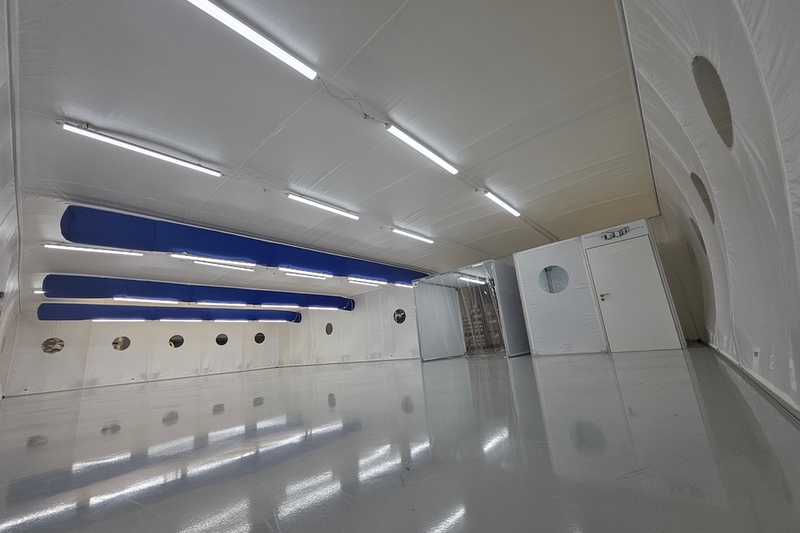
The founder explains that these cleanrooms work through slight overpressure to support ceilings. This overpressure means no steel beams are needed, and it is, essentially, an inflatable structure. This allows the creation of large cleanrooms up to 20m in height with open unobstructued interiors as well as fast installation.
“Tell me only the time, the size, and how many air changes you need, and then you will get exactly the cleanroom you want to have,” Hassa enthuses. Using a “Lego-like” system of fabric panels and zips, he continues to explain that rooms can be installed quickly, dismantled, and even resized mid-project. With the materials being built to withstand daily use by hot air balloons and event spaces, they are more than durable enough for cleanrooms. The custom fabric is the only newly produced material for these spaces, meaning once the space is disassembled, the waste products of these projects are minimal, as most will go on to be reused in future projects.
Often investors don’t want capital locked into “walls”
These rooms require similar air change rates to standard builds. The “tents” are designed and executed according to EN ISO 14644-1, and are available to hit both ISO Class 7 and 8. Hassa explains that the rooms must maintain 20 pascals of pressure, but if not fully in use, it is possible to reduce this. This mirrors the dynamic cleanroom control trend in standard builds.
From an energy sustainability perspective, there is only one major difference in these projects from a full build. A tent has very little insulation. Hassa acknowledged that this could be a problem going forward for fabric-based cleanrooms. With climate change increasing temperatures in countries rapidly, and cleanrooms not being the ideal place to sweat, this is something that needs to be addressed for the future of the market. Hassa is keen to look into this challenge, and explains that active cooling and insulation are two methods that could be taken.
Hassa’s lofty plans for 2026
Looking back on the years that followed this initial build, Hassa explains that despite technical success, the market acceptance was slow. “The cleanroom industry is full of fear,” he says. “They don’t like to change things that are already approved.”
It took some trial and error, but the company soon made a breakthrough with the business model of this new cleanroom. The breakthrough came in the form of offering cleanrooms as rentals with custom sizing rather than fixed, permanent installations.
Hassa explained that the key to this was first-time users, or those experimenting with what was needed. The rental aspect of the business suits customers who need a low-upfront-cost solution for a shorter period of time. Start-ups and small companies are a prime example of a user, as often investors don’t want capital locked into “walls”. This change in approach reshaped everything for Hassa and his team. “The cleanroom should follow the project, not the project the cleanroom,” he explains. By lowering upfront costs and increasing flexibility, the company offered something that was missing on the market.
The concept behind the rental model is more akin to a lease model. Customers pay a monthly fee for ownership, spread over a predetermined amount of time. At the end of this period, the renter has a choice: either ReinraumZelt can collect, clean, and refurbish the majority of components for reuse, or the renter can buy it outright. This is not unlike buying a car on finance. “You can rent it for 14 months, and then you can buy it for one euro,” he says.
You can rent it for 14 months, and then you can buy it for one euro
Hassa stresses that this model is perfect for those testing out their manufacturing process. He explains that they are less focused on pharmaceutical applications, as there is a high degree of fear and heavy regulation. Instead, he points to many industries where this environment is perfect, such as medical devices, food production, and special mechanical production. One such application that he says is taking off is in cannabis packaging. These companies need small, fast-installation cleanrooms that meet GMP standards, for which the tents are well suited.
Operation in Germany is already years old, with many of these cleanroom tents certified and operating successfully there, showing a growing trust in the product. Hassa says the company is also making good progress in Switzerland, where cannabis packaging is growing quickly.
Hassa says his big ambition for 2026 is geographical expansion. With most of the EU relatively harmonised, he thinks this should make expansion easier. Hassa and the team plan for production to stay in Germany, with local partners to handle sales and installation. The idea is that these local franchise partners will need minimal capital, and will mostly need space and a small team.
Hassa’s eyes are particularly on Austria and the Netherlands, as well as in the slightly longer term, Sweden and Norway. With countries like the US having very different regulations and standards, the founder sees this as a much longer-term plan.
Looking ahead
With some huge financial inceptives, and lack of waste products, there are definitely some markets that will be make the most of this expanding cleanroom form. The idea for a lease-model fabric-based cleanroom has now firmly taken root in Germany, but 2026 will see how uptake of this innovative model goes, and if it will find its place in the landscape.


