
Development, validation, and implementation: How to design your pharmaceutical facility disinfection programme

Published: 22-Apr-2026

The development, validation, and implementation of a robust disinfection programme are critical components of Good Manufacturing Practices (GMP). James Polarine, Matt Hofacre and Tony Cundell explain what you need to do

This article provides an overview of the essential elements, including disinfectant validation and efficacy testing. To do this, we will look at regulatory requirements, industry standards, and best practices.

Regulatory background

For the US, cleaning and disinfection in pharmaceutical facilities are governed by US cGMP (21 CFR 211), EU GMP Annex 1 (2022), and industry guidance (USP <1072>, IEST RP 18.5), which emphasise validated methods for aseptic areas and real-world field trials.

The EU's Good Manufacturing Practices (EU GMP) Annex 1, revised in 2022, further elaborates on the requirements for disinfection and bio-decontamination. It highlights the importance of validated decontamination methods for barrier systems such as isolators and Restricted Access Barrier Systems (RABS), as well as the thorough cleaning and disinfection of cleanrooms.

Industry guidance documents, such as the U.S. Pharmacopeia (USP) <1072> and Institute of Environmental Sciences and Technology (IEST) RP 18.5, also offer additional guidance on designing and validating disinfectant efficacy studies. These documents recommend the use of in situ disinfectant field trials to ensure the effectiveness of cleaning and disinfection programmes in real-world conditions.

But what are the specific standards and guidelines that form the foundation of effective cleaning and disinfection validation programmes? Table 1 summarises the key areas within these standards.
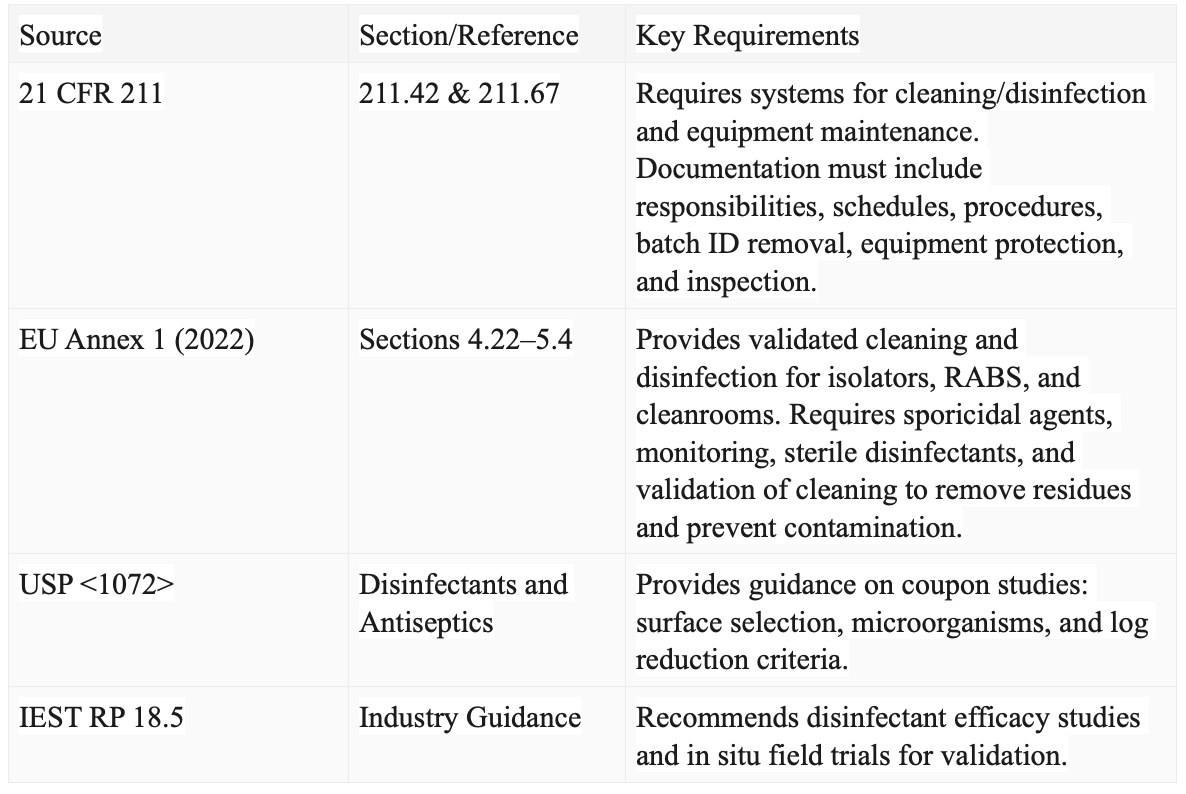
Table 1: Summary of Cleaning and Disinfection Validation Program Standards and Guidelines

Table 1: Summary of Cleaning and Disinfection Validation Program Standards and Guidelines

Choice of cleaning, disinfectant, and sporicidal agents 

Cleaning: For cleanrooms and critical environments, cleaning agents can be used for periodic residue removal or after a worst-case event (such as product spillage or construction) to bring the cleanroom back online. Many disinfectant formulations are one-step cleaner/disinfectants registered with the US Environmental Protection Agency (EPA). Neutral or acidic cleaners are commonly used in cleanrooms for the purpose of periodic residue removal or to remove excessive soiling or particles after a worst-case event. After the application of a cleaner using a polyester or microfibre mopping routine with a double or triple bucket system, it would be best practice to employ a rinse step with Water for Injection (WFI).

Disinfection: The most common disinfectants utilised globally in biopharma and medical device cleanrooms are quaternary ammonium (quads) disinfectants and phenolic disinfectants. Quat disinfectants are known to be excellent cleaners with deodorising abilities. Phenolics are derived from coal tar (carbolic acid) and creosote. As an active ingredient, phenolics can have slightly higher levels of kill than quats against some microorganisms such as Mycobacterium. 

The chemicals attack microorganisms in both broad and specific ways. For example, products with extremely low or high pH levels may present an inherently hostile environment to certain organisms, while the active ingredients (e.g. ortho phenyl phenol or benzalkonium chloride) may act on cell protoplasm or cell surfaces. In other words, not all disinfectants work the same way against all organisms. Further, not all organisms have the same susceptible cell structures. There are real differences in susceptibility between a vegetative bacterium and a bacterial spore. However, there also may be differences between the susceptibility of strains of the same species. Disinfectants should be selected on the basis of performance against common environmental isolates. Further, more than one product must be included in the disinfectant programme in order to obtain broad-spectrum performance. The spectrum should include routine disinfectants, sporicides, and alcohols. 

Sporicidal agent: The disinfectant should be periodically rotated with a sporicide in an effort to address more resistant fungal and bacterial spores. The frequency of application of the sporicide would be based on environmental monitoring data and the frequency of isolation of spore-forming fungi and bacteria. Commonly used sporicides include sodium hypochlorite, hydrogen peroxide/peracetic acid blends, and hydrogen peroxide chemistries in liquid or vapour form.

Periodic rinsing may also take place to remove any disinfectant or sporicide residue build-up over time. WFI can be utilised with a damp mopping method using a two or three bucket system to remove residue built up on walls and floors quarterly, monthly, weekly, or bi-weekly based on visual observations. Detergents may also be considered as a means of removing disinfectant residue, for example for heavier residues on floor surfaces. Residue removal for glass and stainless steel can take place with a 70% isopropanol wiping step.

Disinfectant manufacturer’s testing and registration 

Manufacturers in the US producing sanitisers, disinfectants, and sporicides are regulated by the EPA. The EPA regulates the efficacy, safety, use, and disposal of these products. The efficacy testing required by EPA is based on the Association of Official Analytical Collaboration (AOAC) International guidelines, which provide the testing methodologies for sanitisers, disinfectants, and sporicides.

There are two categories of claims that can be achieved as sanitisers, which are food contact sanitiser claims and non-food contact sanitiser claims. There are three categories of claims for disinfectants, and the most common one utilised in the US is the healthcare grade disinfectant. The EPA Series 810-Product Performance Test Guidelines also has categories for sterilants and hard surface sporicides which are very rigorous and robust tests to pass.

What the disinfectant manufacturer needs and what the cleanroom operator needs vary. The EPA testing employed by disinfectant manufacturers is very robust and technique-sensitive and is required to register products in the US. However, it is not indicative of how the disinfectants will be used in cleanrooms. In essence, lab studies are different to field studies that look at worst case locations.

Disinfectant coupon studies are required to evaluate efficacy on specific cleanroom surfaces and use facility isolates for laboratory simulations to satisfy the regulators in the pharmaceutical and medical device industries (e.g. FDA, MHRA, HPRA, ANVISA, etc.). The coupon studies target 2-log reduction for fungal and bacterial spores and 3-log reduction for vegetative bacteria within an established contact time, (e.g. 10 mins). In contrast, the EPA testing in many cases requires a 5- to 6-log reduction for the disinfectant and sporicidal test and a 3-log reduction for virucidal testing, typically within a 10 min contact time.

The frequency of cleaning and disinfection of an area in a GMP manufacturing facility will depend on the location (e.g: floors, walls, and ceilings), frequency of equipment and personnel traffic in the area, environmental monitoring data, and the ISO classification of the room. This cleaning and disinfection frequency may range from monthly to weekly, to daily, to before and after each shift. It should be emphasised that cleaning to remove grime and product residues prior to the application of disinfectants is critical for their efficacy. The EPA publishes multiple lists of registered disinfectants and sporicidal agents, providing useful information on representative commercially available products.

Laboratory studies to support your programme 

Robert Koch differentiated bactericidal and bacteriostatic activity in the 19th century. He noted that it was essential to neutralise the disinfectant prior to plating so as to not overestimate the log reduction. Modern guidance for cleanrooms has only built on this.

The objective of laboratory studies is to screen and qualify disinfectants for their use in cleanrooms and controlled areas based on the determination of the log reductions for different types of microorganisms on coupons of representative cleanroom surfaces. (See USP <1072> for a list of common cleanroom surfaces.) These laboratory studies often involve applying high concentrations of lab-grown microorganisms onto surfaces of materials used in aseptic processing areas. After drying, the surfaces are treated with a disinfectant, for example for 5-10 minutes, to measure how effectively the disinfectant reduces the microbial load. While these defined and controlled tests are valuable, they do not replicate the full scale application in the cleanroom for the following reasons:

  • The high counts are not representative of the microbial population in a cleanroom, which is considerably lower and randomly distributed on surfaces.
  • The laboratory study does not truly simulate the mop application, drying, and removal of the disinfection and microorganisms from a cleanroom surface.
  • The laboratory study does not truly simulate the distribution of microorganisms and their possible attachment to surfaces in the form of biofilms. 
  • The 10-minute contact time may not be a good simulation of the in-use contact time. 
  • The log reduction acceptance criteria for vegetative cells and bacterial and fungal spores are empirical. 

Current discussions on laboratory studies centre around:  

  • Wet contact time: Should the surface be allowed to dry during the contact time or be rewetted? 
  • Log reduction criteria: What log reduction is acceptable in coupon testing studies?
  • Referencing previous studies: Can published studies be referenced to reduce duplication of efforts?

The above points are being discussed in the industry, and the authors are anticipating more guidance to be developed around these topics. 

USP <1072> explains that in the US, official disinfectant testing methods are defined by AOAC International and must follow GLP standards for EPA registration. To demonstrate efficacy in pharmaceutical environments, additional tests—use-dilution, surface challenge, and statistical comparison of microbial counts—are often needed to validate real-world performance.

The steps in the disinfection validation are often as follows:

  1. Select the challenge microorganisms and cleanroom construction materials.
  2. Fabricate and clean the representative coupons. Note: In practice, smaller coupons may be preferable, which can be vortexed in a dilution tube for convenience for plating for microbial enumeration. Prepare the suspension of the challenge organisms in a buffer.
  3. Inoculate the coupons with the appropriate level of challenge microorganisms.
  4. Dry the coupons in a laminar flow hood.
  5. Apply the use concentration of the disinfectant onto the coupons.
  6. Store the coupons in a laminar flow hood for selected contact time.
  7. Recover and enumerate the challenge organism from the disinfectant test and positive control coupons  after an appropriate contact time (e.g. 10 minutes) by vortexing the coupons in a tube of a diluent containing a neutraliser(s).
  8. Dilute the neutralisation solution into a suitable counting range and plate the inoculum.
  9. Calculate the log reduction and evaluate the result against the USP <1072> acceptance standard of a 2-log reduction for bacterial and fungal spores and a 3-log reduction for vegetative microbial cells.

Choice of challenge microorganisms 

The microorganisms chosen for the coupon study are typically based on the frequency of occurrence, worst-case microorganism, and proximity to sterile production in the APA (Aseptic Processing Area). Typical organisms may include gram-negative and gram-positive vegetative bacteria, yeast and mould, and gram-positive spore-forming bacteria. The risk assessment should consider risk scoring when choosing. Typically, when conducting a disinfectant coupon study, one or two vegetative bacteria, one or two moulds, possibly a yeast and bacterial spore, and (if viruses are a concern and risk) a virus will be tested.

A new cleanroom facility will not have any environmental monitoring data available and will have only reference strain data using ATCC (American Type Culture Collection) microorganisms and common surfaces. Disinfectant manufacturers may generate this type of reference data in addition to the registration testing. For a new cleanroom facility, an option would be to reference the disinfectant manufacturer’s coupon testing studies with ATCC microorganisms. New facilities may take 6-12 months to determine what appropriate environmental isolates are for their coupon testing, and during this time, they may conduct a robust disinfectant field trial as well.

Equipment and SOPs 

The disinfectant or sporicide employed needs to be diluted correctly with WFI by using a graduated cylinder or a unit dose packet. The most common methods of application are double bucket and triple bucket cleaning and disinfection systems. Wipes and impregnated wipes are also often used for cleaning and disinfection in cleanrooms, including the aseptic processing area. The figures below (Figure 1 and Figure 2) illustrate the most common methods of application of disinfectants and sporicides in cleanrooms.

Figure 1: Overlapping Unidirectional Strokes (overlapping by 10-20%)

Figure 1: Overlapping Unidirectional Strokes (overlapping by 10-20%)

Figure 2: Disinfectant application

Figure 2: Disinfectant application

Contract cleaning and disinfection companies are common in the cleanroom industry today with these activities occurring on a second or even third shift. Furthermore, rapid turnover in the temporary workforce can affect cleaning quality. Periodic training as well as audits should take place to be sure that SOPs are being followed.

Trending Articles

  1. You need to be a subscriber to read this article.
    Click here to find out more.

Relevant companies

You may also like