
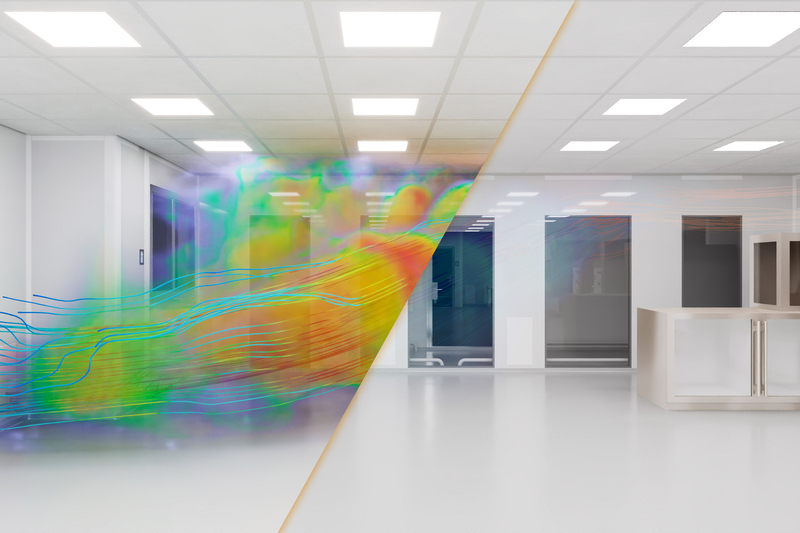
Even after decades of progress in cleanroom design, airflow continues to surprise us. Small changes in geometry, heat load, or equipment placement can alter performance in ways that traditional calculations cannot always predict. These deviations, often invisible until commissioning, are among the most common causes of late-stage adjustments and costly project delays.
Computational Fluid Dynamics (CFD) offers a way to make the invisible visible. By modelling airflow and particle transport before construction begins, CFD allows engineers to test and verify design choices virtually. The result is reduced uncertainty, fewer reworks, and data-driven decisions throughout the project lifecycle.
Turning assumptions into evidence
With CFD, airflow is no longer a matter of educated guesswork. Simulations show how air, temperature, and particles behave within a cleanroom, revealing dead zones, turbulence, and flow paths that affect contamination control and comfort. This clarity enables early design optimisation, long before anything is built.
International standards bodies such as ISO and IEST increasingly acknowledge CFD’s role in performance verification
Seeing performance under real conditions
Conventional design methods simplify reality. CFD adds the missing dimension. By incorporating equipment layouts, operator movements, and process heat loads, simulations depict how the cleanroom will truly perform.
The result is foresight, allowing design teams to make informed adjustments early and saving time, resources, and validation headaches later.
The high cost of late corrections
Once construction is complete, airflow issues become some of the most expensive problems to fix. Rerouting ducts or rebalancing airflows can extend qualification and delay production.
Compared to these costs, investing in CFD at the design stage is minor, and the return in reduced risk and predictable performance is substantial.
The value of CFD goes beyond cost avoidance. It builds


